
Copper Parts and Copper Machined Parts: Precision Engineered Components for
Comprehensive Overview of Copper Component Manufacturing

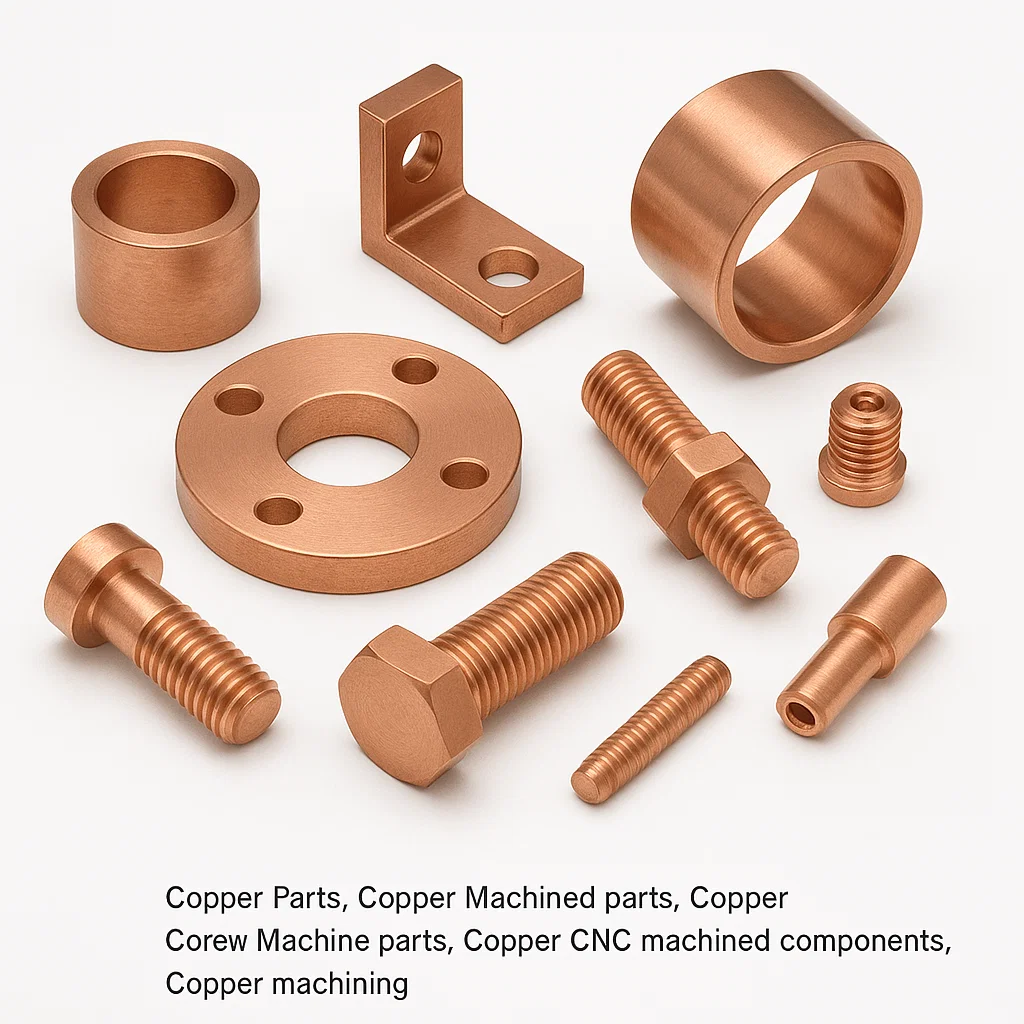
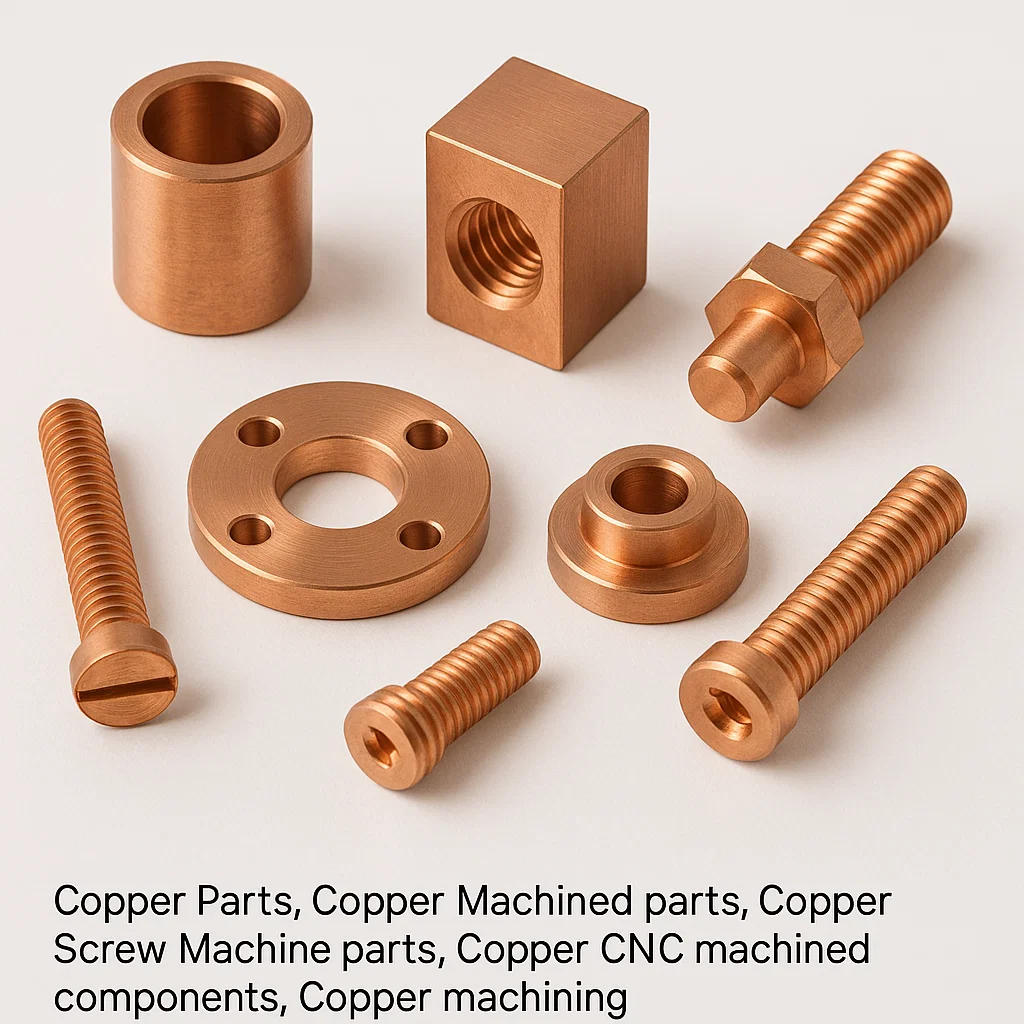
We are one of the leading manufacturers and exporters of Copper parts and Copper machined parts from India. We have been supplying precision engineered Copper components to the world market for many decades. Our state-of-the-art manufacturing facility in Jamnagar combines advanced CNC machining technology with traditional metalworking expertise to produce high-quality Copper machined parts, Copper threaded components, Copper CNC turned parts, and Copper Swiss machined components serving electrical, electronics, HVAC, plumbing, automotive, and industrial equipment sectors worldwide. Copper’s exceptional electrical conductivity (100% IACS for pure grades), superior thermal conductivity (231 BTU/hr·ft·°F), excellent corrosion resistance, and antimicrobial properties make it the material of choice for electrical terminals, heat exchanger components, transformer parts, motor windings, power distribution hardware, grounding components, and thermal management systems. Our three decades of manufacturing experience, combined with ISO 9001:2015, ISO 14001:2015, and ISO 45001:2018 certifications, ensures every Copper part meets stringent dimensional tolerances, surface finish requirements, and material purity standards demanded by customers across North America, Europe, Australia, and Asia. We specialize in both high-volume production runs and custom-designed prototypes, working collaboratively with OEMs, electrical equipment manufacturers, HVAC companies, and industrial distributors to deliver cost-effective solutions optimizing performance, manufacturability, and regulatory compliance.
Copper Parts: Essential Components for Electrical and Industrial Applications
Copper parts encompass a diverse range of components manufactured from pure Copper and Copper alloys through machining, forming, stamping, forging, and casting processes serving critical functions in electrical power distribution, electronic devices, telecommunications infrastructure, heat transfer systems, and fluid handling equipment. The selection of Copper grades depends on application requirements including electrical conductivity, thermal performance, mechanical strength, formability, and corrosion resistance in specific operating environments. Our manufacturing capabilities produce Copper parts ranging from miniature electrical contacts weighing fractions of a gram to substantial transformer components exceeding 50 pounds, with dimensional accuracy controlled through coordinate measuring machines, optical comparators, and statistical process control methodologies. Common Copper parts manufactured at our facility include electrical bus bars for power distribution panels, electrical terminals and lugs for cable connections, grounding clamps and connectors for electrical safety systems, heat sink components for electronics cooling, heat exchanger tubes and fins for HVAC equipment, transformer windings and bushings for power conversion, motor commutator segments for rotating machinery, waveguide components for telecommunications, plumbing fittings and valve components for water distribution, and specialty fasteners for electrical enclosures. The inherent antimicrobial properties of Copper surfaces provide passive sanitation benefits in healthcare facilities, food processing equipment, and public infrastructure applications where touch surfaces contribute to pathogen transmission. Copper parts maintain dimensional stability and mechanical properties across operating temperature ranges from cryogenic conditions below -300°F (-184°C) to elevated temperatures approaching 400°F (204°C), though sustained exposure above 300°F may cause annealing and strength reduction in work-hardened conditions.
Copper Machined Parts: Precision Manufacturing for Demanding Specifications
Copper machined parts represent components produced through subtractive manufacturing processes including CNC turning, CNC milling, drilling, threading, grinding, and electrical discharge machining (EDM) where material removal operations transform raw material forms such as bar stock, plate, rod, and tube into finished precision parts meeting tight dimensional tolerances and surface finish requirements. The machinability characteristics of Copper vary significantly across different grades, with pure oxygen-free Copper exhibiting gummy cutting characteristics requiring sharp tooling and positive rake angles, while tellurium-bearing free-machining Copper grades deliver superior chip breaking, reduced cutting forces, and extended tool life enabling high-speed production. Our machining department operates CNC turning centers with live tooling capabilities, multi-axis CNC machining centers, Swiss-type automatic lathes, multi-spindle screw machines, and precision grinding equipment achieving dimensional tolerances as tight as ±0.0005 inches (±0.013mm) on critical features with surface finishes ranging from 125 microinches Ra for general commercial applications to 16 microinches Ra for precision electrical contacts and sealing surfaces. Threading operations on Copper machined parts produce NPT pipe threads, BSPT threads, metric threads, machine screw threads, and custom thread forms using single-point threading, thread milling, thread rolling, and tapping operations with thread class tolerances from 1A/1B (loose fit) to 3A/3B (tight fit) depending on assembly requirements. Complex geometries achievable through Copper CNC machining include multi-port manifolds with intersecting internal passages, heat sink profiles with intricate fin geometries, electrical terminals with precise insertion dimensions, transformer bushings with concentric cylindrical features, and specialty connectors requiring geometric dimensioning and tolerancing controls including true position, perpendicularity, concentricity, and surface profile specifications.
Copper Screw Machine Parts: High Volume Production Components
Copper screw machine parts constitute cylindrical components produced on automatic screw machines, Swiss-type automatic lathes, and multi-spindle turning equipment where rotational symmetry enables efficient high-volume manufacturing with remarkable dimensional consistency across production runs exceeding hundreds of thousands of pieces. These parts include electrical terminals, connector pins, contact springs, threaded studs, spacers, bushings, sleeves, shafts, nozzles, and specialty fasteners used throughout electrical equipment assemblies, automotive electrical systems, consumer electronics, and industrial control panels. Our screw machine operations utilize CNC Swiss-type lathes equipped with guide bushing support enabling production of small-diameter parts with length-to-diameter ratios exceeding 10:1 while maintaining concentricity tolerances within 0.001 inches (0.025mm) total indicator runoff. Bar feeding systems provide automatic material delivery enabling lights-out manufacturing for overnight production runs, with programmable bar loaders accommodating stock diameters from 3mm to 32mm (1/8 inch to 1-1/4 inches). The screw machining process sequence typically includes facing, rough turning, finish turning, threading, grooving, drilling, cross-drilling, knurling, and part-off operations completed within cycle times ranging from 15 seconds for simple geometries to 90 seconds for complex multi-feature components. Tool selection for Copper screw machining emphasizes sharp cutting edges, positive rake geometries, and carbide or polycrystalline diamond (PCD) inserts that minimize built-up edge formation common when machining pure Copper grades. Quality control procedures include in-process statistical monitoring of critical dimensions at 30-minute intervals, automatic dimensional verification using laser micrometers and optical measuring systems, and final inspection protocols verifying conformance to customer specifications before components proceed to packaging operations.
Copper CNC Machined Components: Advanced Manufacturing Precision
Copper CNC machined components combine computer numerical control manufacturing technology with optimized cutting parameters, advanced tooling systems, and sophisticated workholding fixtures to produce complex three-dimensional geometries with exceptional accuracy and repeatability. Our CNC machining capabilities encompass 3-axis vertical machining centers for plate and block machining, 4-axis horizontal machining centers for prismatic parts requiring multiple-side access, 5-axis simultaneous machining centers for sculptured surfaces and compound angles, and CNC turning centers with sub-spindle transfer for complete part machining in single setups. Programming expertise utilizing computer-aided manufacturing (CAM) software generates optimized tool paths minimizing cycle time while maintaining surface finish quality, avoiding tool deflection on thin-wall features, and maximizing material removal rates during roughing operations. Fixture design for Copper CNC machining incorporates soft jaw systems, vacuum workholding, magnetic chucks for plate machining, and hydraulic clamping providing secure retention without deforming soft Copper material or leaving witness marks on finished surfaces. Cutting tool management systems organize tooling by operation sequence, measure tool geometry compensating for thermal expansion and wear, and track tool life cycles ensuring replacement before dimensional drift affects part quality. Complex features produced in Copper CNC machined components include internal cooling passages for heat sinks, intersecting electrical bus bar galleries, tapered pin sockets with precise cone angles, multi-start lead screw threads, interrupted threads on electrical terminals, and sculptured heatsink profiles optimized for thermal dissipation through computational fluid dynamics analysis.
Copper Machining: Comprehensive Manufacturing Processes
Copper machining encompasses the complete spectrum of material removal operations applied to pure Copper grades and Copper alloy compositions, requiring specialized knowledge of cutting parameters, tool geometries, coolant strategies, and workholding techniques that address the unique challenges posed by Copper’s high thermal conductivity, tendency toward work hardening, and gummy chip formation characteristics. Cutting speeds for oxygen-free electronic grade Copper (C10100, C10200) typically range from 200 to 400 surface feet per minute using sharp carbide tooling, while free-machining tellurium Copper (C14500) permits speeds exceeding 800 surface feet per minute with extended tool life and superior surface finish quality. Feed rates must be balanced between productivity demands and surface finish requirements, with typical roughing feeds between 0.010 and 0.020 inches per revolution for turning operations and finishing feeds between 0.003 and 0.008 inches per revolution producing surface finishes suitable for electrical contact applications. Coolant selection plays critical roles in Copper machining operations, with water-soluble synthetic coolants providing excellent heat removal and chip flushing while preventing copper staining, and straight cutting oils delivering superior lubricity for deep hole drilling and tapping operations where cutting tool engagement is continuous. Machining-induced work hardening occurs readily in pure Copper grades, with surface layers experiencing significant strength increases during cutting operations that can complicate subsequent machining passes if not addressed through proper depth of cut selection and tool path strategies. Secondary machining operations including reaming, boring, counterboring, countersinking, chamfering, deburring, and edge breaking ensure that every machined feature meets drawing specifications with sharp edges removed preventing handling injuries and assembly interference.
ETP Copper Parts: Electrolytic Tough Pitch Copper Components
ETP Copper parts are manufactured from electrolytic tough pitch Copper (UNS C11000, also designated as ETP Copper or E-Copper) representing the most widely specified commercial Copper grade containing minimum 99.9% Copper with controlled oxygen content between 0.02% and 0.04% providing optimal balance of electrical conductivity (101% IACS minimum), mechanical properties, and manufacturing cost-effectiveness for general electrical applications. This grade serves as the foundation material for electrical wire and cable, bus bars, transformer windings, motor components, printed circuit board laminates, and architectural roofing and flashing applications where maximum electrical conductivity is essential. Our ETP Copper parts production encompasses cold-worked and annealed temper conditions designated by ASTM standards including H00 (annealed soft), H01 (light cold worked), H02 (half hard), H04 (hard), and H08 (spring hard) providing progressively increasing tensile strength and reduced elongation as cold work severity increases. Annealing operations at temperatures between 700°F and 1200°F (370°C to 650°C) restore ductility in work-hardened material enabling subsequent forming operations such as bending, deep drawing, spinning, and swaging without cracking or surface defects. The primary limitation of ETP Copper involves susceptibility to hydrogen embrittlement when exposed to reducing atmospheres at elevated temperatures above 750°F (400°C), where residual oxygen forms steam pockets causing internal cracking and mechanical failure. Applications requiring brazing, welding, or high-temperature service above 750°F should specify oxygen-free grades (C10100, C10200) or deoxidized Copper alloys (C12000, C12200) that eliminate hydrogen embrittlement concerns through controlled composition and processing.
Copper Threaded Parts: Precision Thread Forms for Reliable Connections
Copper threaded parts incorporate external threads, internal threads, or both thread types providing mechanical fastening, electrical continuity, or pressure-tight sealing in electrical enclosures, grounding systems, plumbing installations, and equipment assemblies. Thread manufacturing methods for Copper components include single-point thread turning on CNC lathes producing custom thread forms and large diameter threads, thread milling operations creating internal and external threads with excellent accuracy, thread rolling cold forming external threads with work-hardened surfaces and superior fatigue strength, and tapping operations cutting internal threads in drilled holes. Standard thread specifications applied to Copper threaded parts include Unified National Coarse (UNC) and Fine (UNF) threads per ASME B1.1, metric coarse and fine threads per ISO 68-1, NPT taper pipe threads per ASME B1.20.1 for plumbing connections, BSPT British standard pipe threads for international markets, and ACME threads for mechanical power transmission applications. Thread class tolerances specify the allowable dimensional variations in pitch diameter, major diameter, and minor diameter, with Class 1A/1B providing loose fit for ease of assembly, Class 2A/2B representing standard commercial quality balancing assembly ease with strength, and Class 3A/3B delivering precision close-fit threads for critical applications requiring minimal clearance. Threading operations on soft annealed Copper require sharp tap geometries, slow cutting speeds, and generous lubrication preventing thread tearing and excessive torque that can break taps inside valuable workpieces. Inspection procedures for Copper threaded parts utilize thread ring gauges verifying external thread acceptance, thread plug gauges checking internal thread quality, optical comparators measuring thread profile geometry, and coordinate measuring machines quantifying pitch diameter dimensions with sub-thousandth inch accuracy.
Copper CNC Turned Parts: Rotational Symmetry Precision Components
Copper CNC turned parts represent cylindrical components produced on computer numerical control turning centers and CNC lathes where workpiece rotation enables cutting tools to generate concentric features including external diameters, internal bores, tapers, contours, grooves, threads, and face features. Our turning department operates CNC lathes ranging from compact bench-top machines handling work up to 6 inches diameter to large capacity machines accommodating components up to 24 inches diameter and 60 inches length. Live tooling capabilities integrate powered rotating tools into turning operations, enabling cross-drilling, end milling, and off-center feature machining without secondary setup operations that risk misalignment and tolerance accumulation. Sub-spindle transfer capabilities on advanced turning centers enable backside machining operations, producing completely finished parts in single setups that minimize handling time, eliminate fixturing witness marks, and improve geometric accuracy between front and back features. Typical Copper CNC turned parts include electrical terminals with external threads and hex wrench flats, transformer bushings with concentric cylindrical steps and internal cooling passages, motor shafts with multiple diameter steps and keyways, heat sink bodies with external fin geometries, valve stems with threaded ends and sealing surface grooves, connector shells with precise internal dimensions for contact retention, and specialty fasteners with combination hex heads and threaded shanks. Turning operations achieve exceptional concentricity tolerances within 0.0005 inches (0.013mm) total indicator runoff on precision spindles with minimal bearing clearance, while surface finish quality reaches 32 microinches Ra or better through proper insert selection, cutting parameter optimization, and rigid machine tool construction minimizing chatter and vibration.
Copper Swiss Machined Components: Ultra-Precision Small Diameter Parts
Copper Swiss machined components are produced on Swiss-type automatic lathes incorporating guide bushing support that constrains material immediately adjacent to the cutting zone, enabling ultra-precise machining of small-diameter parts with high length-to-diameter ratios while maintaining exceptional dimensional accuracy and surface finish quality. This manufacturing method excels at producing Copper connector pins, electrical terminals, contact springs, precision shafts, nozzles, and miniature threaded components with diameters ranging from 0.062 inches (1.5mm) to 1.250 inches (32mm) and lengths up to 12 inches (300mm). The guide bushing support eliminates workpiece deflection during cutting operations, achieving position tolerances within ±0.0002 inches (±0.005mm) and diameter tolerances within ±0.0005 inches (±0.013mm) on features located multiple inches from the spindle collet. Swiss machines incorporate gang-style tooling arrangements where multiple cutting tools operate simultaneously on the workpiece, dramatically reducing cycle time compared to turret-style lathes where tools engage sequentially. Our Swiss machining capabilities include main spindle operations for primary turning and facing, sub-spindle transfer for backside machining, live tooling for cross-drilling and milling operations, and automatic bar feeding systems enabling continuous production with minimal operator intervention. Complex Copper Swiss machined components feature combinations of turned diameters, threaded sections, cross-drilled holes, hexagonal wrench flats, knurled surfaces, and grooves all produced within single machine cycles lasting 30 to 120 seconds depending on part complexity. Quality assurance for Swiss machined components utilizes in-process laser measurement systems monitoring critical diameters during production, automatic vision inspection systems detecting surface defects, and coordinate measuring machines validating first article approval and periodic production sampling conformance to drawing specifications.
Material Grades and International Standards for Copper
Understanding Copper grade designations across international nomenclature systems enables accurate material specification and sourcing:
| Material Designation | Composition | Standard | Conductivity | Key Characteristics | Applications |
|---|---|---|---|---|---|
| C10100 (Oxygen-Free) | Cu 99.99% min, O <0.001% | ASTM B170 | 101% IACS | Highest purity, no hydrogen embrittlement | Electronics, conductors |
| C10200 (OF Copper) | Cu 99.95% min, O <0.001% | ASTM B152 | 101% IACS | High purity, weldable | Bus bars, waveguides |
| C11000 (ETP Copper) | Cu 99.90% min, O 0.02-0.04% | ASTM B152 | 101% IACS | Standard electrical grade | Wire, electrical parts |
| C14500 (Tellurium) | Cu 99.5%, Te 0.4-0.7% | ASTM B301 | 93% IACS | Free-machining, high speed | Screw machine parts |
| Cu-ETP (European) | Cu 99.90% min | EN 1976 | 58 MS/m | EU standard electrical | European electrical |
| Cu-OFE (European) | Cu 99.99% min | EN 13605 | 58 MS/m | Oxygen-free electronic | High-end electronics |
| T2 (Chinese) | Cu 99.90% min | GB/T 5231 | ≥57 MS/m | Chinese standard Copper | Chinese market |
| C1100 (Japanese) | Cu 99.90% min | JIS H3100 | 101% IACS | Japanese tough pitch | Japanese market |
| C1020 (Japanese OF) | Cu 99.96% min | JIS H3100 | 101% IACS | Oxygen-free grade | Electronics Japan |
Indian Standards: IS 191 specifies Copper cathodes, IS 1897 covers Copper wire bars, IS 613 addresses Copper sections and rods.
Manufacturing Processes and Machinery
CNC Turning Centers: DMG MORI NLX series, Mazak Integrex multi-tasking machines, Haas ST-series with live tooling, bar feeders, sub-spindles enabling complete part machining.
Swiss-Type Lathes: Citizen Cincom A20, Star SR-20R machines with guide bushing support, gang tooling, automatic bar loading for high-volume precision production.
CNC Machining Centers: Makino V33, Mazak Variaxis 5-axis machining centers, Haas VF-series mills with 40-taper spindles, through-spindle coolant delivery.
Multi-Spindle Screw Machines: Davenport 6-spindle automatics for ultra-high volume Copper terminal and connector production exceeding 10,000 pieces daily.
EDM Equipment: Wire EDM and sinker EDM machines for producing complex cavities and features difficult to machine conventionally in Copper alloys.
Quality Inspection: Mitutoyo CMM systems, Keyence optical comparators, Mitutoyo surface roughness testers, Olympus microscopes for metallurgical inspection.
Typical Copper Parts and Dimensional Reference
Electrical Components: Bus bars (rectangular profiles 1/4″ × 2″ to 1″ × 6″), electrical terminals (diameters 0.125″ to 1.5″), grounding lugs, transformer bushings.
Heat Transfer Parts: Heat sink bodies, cold plates, heat exchanger tubes (0.375″ to 2″ OD), thermal spreaders for power electronics.
Connector Components: Pin contacts (0.040″ to 0.125″ diameter), socket contacts, coaxial center conductors, RF connector bodies.
Plumbing Fittings: Compression ferrules, pipe nipples, valve seats, pump impellers in Copper-Nickel alloys for seawater service.
Standard Tolerance Capabilities
| Feature Type | Standard Tolerance | Precision Tolerance |
|---|---|---|
| Turned Diameters | ±0.002″ (±0.05mm) | ±0.0005″ (±0.013mm) |
| Machined Features | ±0.005″ (±0.13mm) | ±0.001″ (±0.025mm) |
| Hole Locations | ±0.003″ (±0.076mm) | ±0.001″ (±0.025mm) |
| Thread Pitch Diameter | Class 2A/2B | Class 3A/3B |
| Surface Finish | 63 µin Ra | 16 µin Ra |
| Concentricity | 0.002″ TIR | 0.0005″ TIR |
Surface Finishes and Plating Options
Tin Plating: Matte or bright tin deposits 0.0001″ to 0.0005″ thick enhance solderability, prevent oxidation, reduce contact resistance in electrical terminals.
Nickel Plating: Electroless or electrolytic nickel 0.0002″ to 0.001″ thick provides corrosion protection, wear resistance, and barrier preventing Copper migration.
Silver Plating: Thin silver deposits 0.00005″ to 0.0002″ maximize electrical conductivity for high-frequency RF connectors and power distribution contacts.
Gold Plating: Gold over nickel barrier prevents corrosion in harsh environments, maintains low contact resistance for connector applications requiring 10+ year service life.
Passivation: Chemical treatments remove surface contaminants and create passive oxide layer preventing tarnishing during storage and handling.
Bright Dipping: Acid cleaning produces reflective mirror-bright surface appearance for decorative architectural Copper applications.
Industries Served and Applications
Electrical Equipment Manufacturing: Power distribution panels, transformer assemblies, motor windings, generators, switchgear components requiring maximum electrical conductivity.
Electronics and Telecommunications: Printed circuit boards, RF connectors, coaxial cable components, semiconductor lead frames, electronic packaging for thermal management.
HVAC and Refrigeration: Heat exchanger tubes, evaporator coils, condenser components, thermal expansion valves utilizing Copper’s thermal conductivity.
Automotive Industry: Electrical wiring harnesses, starter motor components, alternator parts, heat exchangers, brake system components.
Renewable Energy Systems: Solar panel connectors, wind turbine electrical components, battery terminals, inverter bus bars for solar installations.
Medical Equipment: MRI machine components, X-ray equipment parts, surgical instrument elements, antimicrobial touch surfaces in healthcare facilities.
Industrial Machinery: Welding equipment components, electrode holders, spot welding tips, industrial robot electrical connections.
Performance Metrics and Quality Standards
Electrical Conductivity Verification: Every Copper lot undergoes conductivity testing per ASTM B193 ensuring minimum 100% IACS for high-purity grades.
Dimensional Accuracy: Statistical process control demonstrates Cpk values exceeding 1.67 on controlled features, with 99.9% of dimensions within specified tolerances.
Surface Finish Quality: Contact profilometer measurements document Ra values, with production averages 32 µin Ra and precision ground surfaces achieving 16 µin Ra.
Material Purity Testing: Optical emission spectrometry and X-ray fluorescence verify Copper content, trace element levels, and grade conformance to specification.
Thread Quality: Thread gauges verify pitch diameter, functional length, and thread class conformance ensuring reliable assembly and electrical continuity.
Standard Production Timeline: 4-6 Weeks
Our manufacturing cycle encompasses raw material procurement (3-5 days), production planning and CNC programming (2-3 days), machining operations (2-3 weeks), surface treatment and finishing (3-5 days), quality inspection (2-3 days), and packaging preparation (1-2 days). Expedited production available for urgent requirements with 2-3 week turnaround for quantities under 10,000 pieces. Sample quantities typically ship within 7-10 business days enabling rapid design validation.
Comprehensive Technical Questions and Answers
Q1: What is the difference between oxygen-free Copper and electrolytic tough pitch Copper for machined components? Oxygen-free Copper (C10100, C10200) contains less than 0.001% oxygen, eliminating hydrogen embrittlement susceptibility during brazing or welding operations. ETP Copper (C11000) contains 0.02-0.04% oxygen providing excellent conductivity at lower cost but cannot be used in reducing atmospheres above 750°F without risk of embrittlement.
Q2: Why does pure Copper exhibit gummy cutting characteristics compared to Brass during machining operations? Pure Copper’s face-centered cubic crystal structure and high ductility cause continuous chip formation without natural breaking points. Built-up edge forms on cutting tools reducing surface finish quality. Tellurium-bearing free-machining grades (C14500) incorporate chip-breaking particles enabling 3-4 times faster machining speeds with superior finishes.
Q3: How does work hardening affect Copper machining operations and what strategies minimize this challenge? Copper work hardens rapidly during plastic deformation, with surface hardness increasing 40-60% after cold working operations. Maintain sufficient depth of cut (minimum 0.010″) to cut below work-hardened layers, use sharp tooling with positive rake angles, and optimize feed rates preventing rubbing that exacerbates work hardening without productive material removal.
Q4: What surface treatments prevent tarnishing on Copper electrical terminals during storage before assembly? Tin plating provides excellent oxidation protection while maintaining solderability. Clear acrylic conformal coatings offer temporary protection removed before assembly. Passivation treatments create thin oxide layers slowing tarnish formation. Vacuum packaging with desiccant prevents atmospheric exposure. Silver plating maintains low contact resistance without tarnish concerns in controlled environments.
Q5: Can Copper threaded parts be thread rolled rather than cut to improve fatigue strength? Yes, thread rolling cold forms threads through plastic deformation, creating work-hardened surfaces with continuous grain flow increasing fatigue strength 20-30% compared to cut threads. However, Copper’s ductility requires powerful rolling machines and may cause dimensional growth requiring compensation in blank diameter calculations and thread relief undercuts preventing material buildup.
Q6: What tolerances are achievable on small diameter Copper pins produced through Swiss machining? Swiss-type lathes with guide bushing support achieve diameter tolerances ±0.0005″ (±0.013mm), length tolerances ±0.003″ (±0.076mm), and concentricity 0.0005″ TIR on pins 0.062″ to 0.250″ diameter. Position tolerances for cross-drilled holes reach ±0.0002″ (±0.005mm) when located near guide bushing. Surface finishes 16-32 µin Ra are standard.
Q7: How do you prevent Copper staining when using water-soluble coolants during machining operations? Select synthetic coolants formulated specifically for Copper with corrosion inhibitors and pH buffers maintaining neutral 8.5-9.5 pH range. Ensure adequate coolant concentration (typically 5-8%). Minimize air exposure during machining. Clean parts promptly after machining using alkaline cleaners followed by water rinse and air drying. Apply temporary protective coatings immediately after cleaning.
Q8: What inspection methods verify electrical conductivity meets specification without destroying parts? Eddy current testing per ASTM B193 non-destructively measures electrical conductivity comparing induced eddy current response against calibration standards. Portable conductivity meters provide rapid %IACS readings on production parts. Four-point probe resistance measurements verify conductor resistance. Material certifications from suppliers document mill test results for Copper purity and conductivity for each heat lot.
Q9: Can Copper components be anodized similar to Aluminum for corrosion protection and appearance? Copper does not form stable anodic oxide layers like Aluminum. Chemical conversion coatings create thin protective films but lack anodizing durability. Electroplating with nickel, tin, or precious metals provides superior corrosion protection. Organic coatings including powder coating and liquid paints adhere well to properly prepared Copper surfaces when corrosion resistance outweighs electrical conductivity requirements.
Q10: What design considerations minimize manufacturing costs for high-volume Copper screw machine parts? Specify standard drill sizes avoiding special tooling. Maximize symmetry enabling efficient turning operations. Avoid extremely tight tolerances (±0.0005″) on non-critical features permitting faster cutting speeds. Specify thread lengths accommodating standard tap depths. Use standard thread forms (UNC, UNF, metric) rather than custom threads. Design generous chamfers and edge breaks producible through form tools rather than secondary deburring operations.
Q11: How does Copper grade selection affect material cost and should pure grades be specified unnecessarily? Oxygen-free Copper (C10100) costs 15-30% premium versus ETP Copper (C11000) due to additional refining processes. Free-machining tellurium Copper (C14500) costs similar to ETP but reduces machining time 30-40% potentially offsetting material premium for high-volume runs. Specify minimum grade meeting application requirements rather than unnecessarily pure grades increasing costs without performance benefits.
Q12: What heat treatment processes can modify Copper properties for specific application requirements? Annealing at 700-1200°F (370-650°C) softens work-hardened Copper restoring ductility for subsequent forming. Stress relieving at 300-500°F (150-260°C) reduces residual stresses without significant softening. Solution treating Copper alloys dissolves second-phase particles followed by precipitation aging increasing strength. Cryogenic treatment at -300°F (-184°C) stabilizes dimensions for precision applications requiring minimal thermal expansion.
Q13: How do you ensure dimensional accuracy when machining thin-wall Copper components susceptible to deflection? Utilize rigid fixturing with support near cutting zones minimizing cantilever distances. Reduce cutting forces through lighter depths of cut (0.005-0.020″) and increased cutting speeds. Employ sharp tooling geometries minimizing cutting pressure. Machine in multiple light passes rather than single heavy cuts. Consider internal support mandrels for thin-wall tubes during machining operations preventing collapse or distortion.
Q14: What documentation and certifications accompany Copper component shipments for traceability? Material test reports document alloy composition, mechanical properties, and conductivity from original Copper supplier. Certificates of conformance state compliance with drawing specifications and inspection results. Dimensional inspection reports provide actual measurements of critical features. Heat lot traceability links components to raw material certifications. RoHS declarations verify restricted substance compliance for electronic applications requiring lead-free, cadmium-free materials.
Q15: Can Copper parts be produced with mixed temper conditions combining soft annealed and hard sections? Yes, selective heat treatment enables localized annealing of specific areas while maintaining work-hardened conditions elsewhere. Induction heating provides precise thermal control for spot annealing. Alternatively, design parts with separate components joined through brazing, welding, or mechanical fastening where one component is annealed for formability and another remains hard for strength or spring properties.
Why Choose Conex Metals for Copper Components
Three Decades of Manufacturing Expertise: Our extensive experience machining Copper grades from oxygen-free electronic Copper to free-machining tellurium Copper ensures we understand the unique challenges each grade presents, optimizing cutting parameters, tooling selections, and fixturing strategies that maximize productivity while maintaining quality standards.
Engineering Partnership Approach: Our team doesn’t simply manufacture your designs—we collaborate to optimize component geometry for manufacturability, suggest tolerance rationalization reducing costs without compromising functionality, and propose alternative manufacturing methods potentially improving quality while reducing piece price through process selection aligned with order quantity and geometric complexity.
Advanced Manufacturing Technology: Continuous investment in CNC machining centers, Swiss-type automatic lathes, multi-spindle screw machines, and precision inspection equipment ensures we maintain technological leadership, delivering tight tolerances, superior surface finishes, and complex geometric features competitors struggle to produce consistently at competitive pricing.
Responsive Global Communication: Despite operating from India, our customer service team responds to email inquiries within 4 hours during business days, provides detailed quotations within 24 hours of receiving RFQ packages, and maintains dedicated account representatives familiar with your projects enabling seamless communication across time zones through email, video conferencing, and WhatsApp messaging.
Flexible Production Scheduling: We accommodate varying order quantities from prototype samples to production volumes exceeding 100,000 pieces annually, adjusting manufacturing processes to suit volume requirements. Expedited production options deliver urgent orders in 2-3 weeks when project schedules demand accelerated turnaround beyond standard 4-6 week lead times.
Customized Packaging Solutions: Private labeling services apply your company logo, part numbers, and handling instructions to packaging enabling direct shipment to your customers without repackaging labor. Custom packaging configurations protect delicate Copper parts during international shipping while optimizing freight cube utilization minimizing transportation costs and environmental impact.
ISO Certified Quality Systems: ISO 9001:2015, ISO 14001:2015, and ISO 45001:2018 certifications demonstrate our commitment to quality management, environmental responsibility, and workplace safety through documented procedures, management oversight, and continuous improvement methodologies integrated throughout our manufacturing operations.
Competitive Pricing Structure: Operating from India provides labor cost advantages versus North American and European manufacturers while maintaining quality standards through modern equipment and rigorous training programs. Transparent pricing includes all manufacturing costs, surface treatments, packaging, and domestic transportation without surprise charges appearing at shipment receipt.
Customer Testimonials
Michael Thompson, Engineering Manager, Chicago, Illinois, USA: “Conex Metals has been our Copper machining partner for over six years supplying bus bars, electrical terminals, and custom connector components for industrial control panels. Their engineering team’s suggestions for tolerance relaxation on non-critical features reduced our component costs 18% while maintaining the tight dimensional requirements on electrical contact surfaces that affect performance. Communication has been outstanding with detailed quotations addressing every specification question and proactive production status updates eliminating surprises. .”
David Richardson, Procurement Director, Southampton, United Kingdom: “Our company designs thermal management systems for high-power electronics requiring custom Copper heat sinks, cold plates, and heat spreader components with intricate geometries and tight flatness tolerances. Conex Metals demonstrated exceptional technical capability machining oxygen-free Copper parts maintaining flatness within 0.002″ across 6-inch square plates—a specification domestic suppliers quoted at premium pricing with extended lead times.”
Glossary of Technical Terms
IACS (International Annealed Copper Standard): Conductivity rating scale where 100% IACS represents pure annealed Copper electrical conductivity at 20°C, used to compare electrical performance of Copper grades and other conducting materials.
Oxygen-Free Copper: Ultra-high purity Copper containing less than 0.001% oxygen, designated C10100 or C10200, eliminating hydrogen embrittlement susceptibility during brazing, welding, or high-temperature service in reducing atmospheres.
ETP Copper (Electrolytic Tough Pitch): Standard commercial Copper grade C11000 containing 99.9% minimum Copper with 0.02-0.04% oxygen providing excellent electrical conductivity and cost-effectiveness for general electrical applications.
Work Hardening: Strengthening mechanism occurring during cold deformation where dislocation density increases, raising yield strength and hardness while reducing ductility until annealing restores softness.
Guide Bushing: Precision component in Swiss-type automatic lathes supporting workpiece immediately adjacent to cutting zone, enabling small-diameter parts with high length-to-diameter ratios while maintaining exceptional accuracy.
Thermal Conductivity: Material property describing heat transfer efficiency, measured in BTU/hr·ft·°F or W/m·K, where Copper’s exceptional 231 BTU/hr·ft·°F makes it ideal for heat exchangers and thermal management systems.
Conductivity Testing: Non-destructive measurement using eddy current techniques per ASTM B193 verifying electrical conductivity meets grade specification without destroying parts during production quality control.
Dezincification: Corrosion mechanism affecting Brass where Zinc selectively leaches leaving porous Copper structure. Not applicable to pure Copper but relevant when discussing Copper alloy selection for corrosive environments.
True Position: Geometric tolerance specifying allowable location deviation from theoretically exact position, particularly important for hole patterns on electrical bus bars and connector mounting interfaces requiring precise alignment.
Surface Roughness (Ra): Arithmetic average deviation of surface profile from centerline measured in microinches or micrometers, where electrical contact applications require Ra values below 32 µin for reliable low-resistance connections.
Related Parts:
Copper parts manufacturer, Copper machined components, Copper CNC machining, Copper screw machine parts, Copper turned parts, precision Copper machining, ETP Copper parts, oxygen-free Copper components, Copper electrical terminals, Copper bus bars, Copper heat sink machining, Copper Swiss machined parts, Copper threaded components, Copper connector parts, Copper manufacturing India, Copper parts exporter, custom Copper machining, CNC Copper parts,
Similar Connected Parts:
Copper alloy machining, electrical Copper components, high conductivity Copper parts, Copper terminal manufacturing, Copper pin machining, Copper bushing parts, Copper fastener manufacturing, Copper heat exchanger components, Copper plumbing parts, Copper transformer parts, Copper grounding components, Copper alloy C11000 parts, tellurium Copper machining, free-machining Copper parts, Copper component supplier, precision Copper turned parts, ISO certified Copper manufacturer.
Contact Us for Your Copper Component Requirements
Request a Detailed Technical Quotation: Email your drawings, specifications, and quantity requirements to our engineering team. We provide comprehensive quotations within 24 hours including material costs, machining operations, surface treatments, and delivery schedules with transparent pricing structure.
Download Our Copper Machining Capabilities Brochure: Request our detailed brochure documenting equipment capabilities, tolerance specifications, material grade expertise, quality certifications, and case studies demonstrating complex projects completed for customers worldwide.
Schedule an Engineering Consultation: Our technical team offers complimentary design review sessions analyzing your requirements, discussing manufacturing challenges, and proposing optimized solutions. Video conferencing enables effective collaboration regardless of geographic location.
Request Material Samples: First-time customers receive machined samples demonstrating our quality standards, surface finish capabilities, and dimensional accuracy before committing to production orders. Sample turnaround typically 7-10 business days.
Connect via WhatsApp: For rapid communication and real-time technical discussions, connect with our customer service team via WhatsApp for instant responses to questions and production status updates.
Telephone Contact: Speak directly with our sales engineers during business hours India Standard Time (GMT+5:30), Monday through Saturday, with callback scheduling accommodating international time zones.
We look forward to becoming your trusted partner for Copper parts and Copper machined components, delivering the precision, quality, and reliability your applications demand.
Conex group
Precision Copper Machining | Global Experience | Engineering Excellence
Jamnagar, Gujarat, India
Updated: 2025