
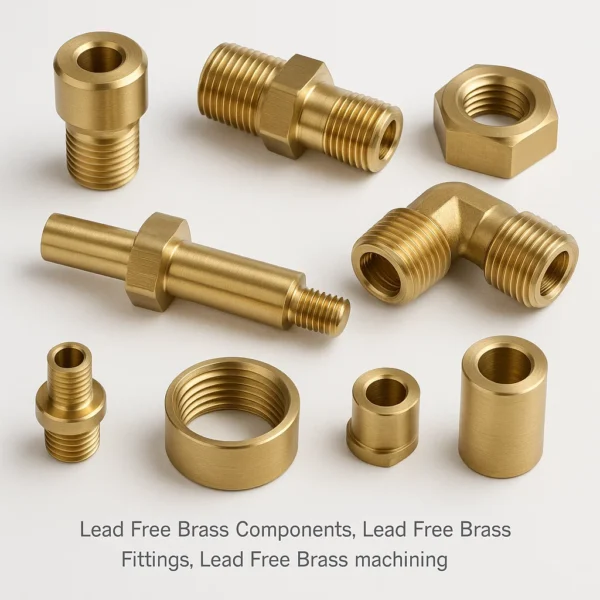
Precision Lead Free Parts, Lead Free Brass parts, Lead Free Brass Fittings, Lead Free Brass Machining
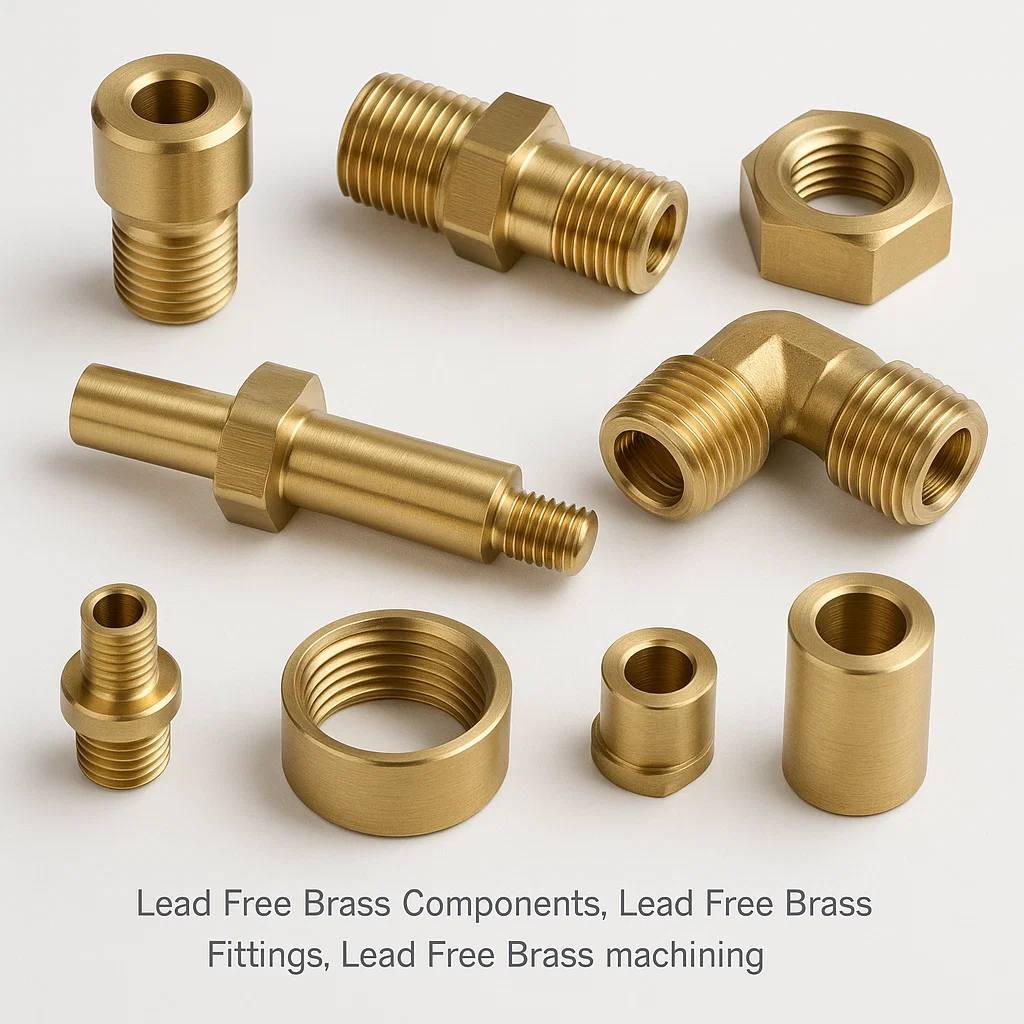
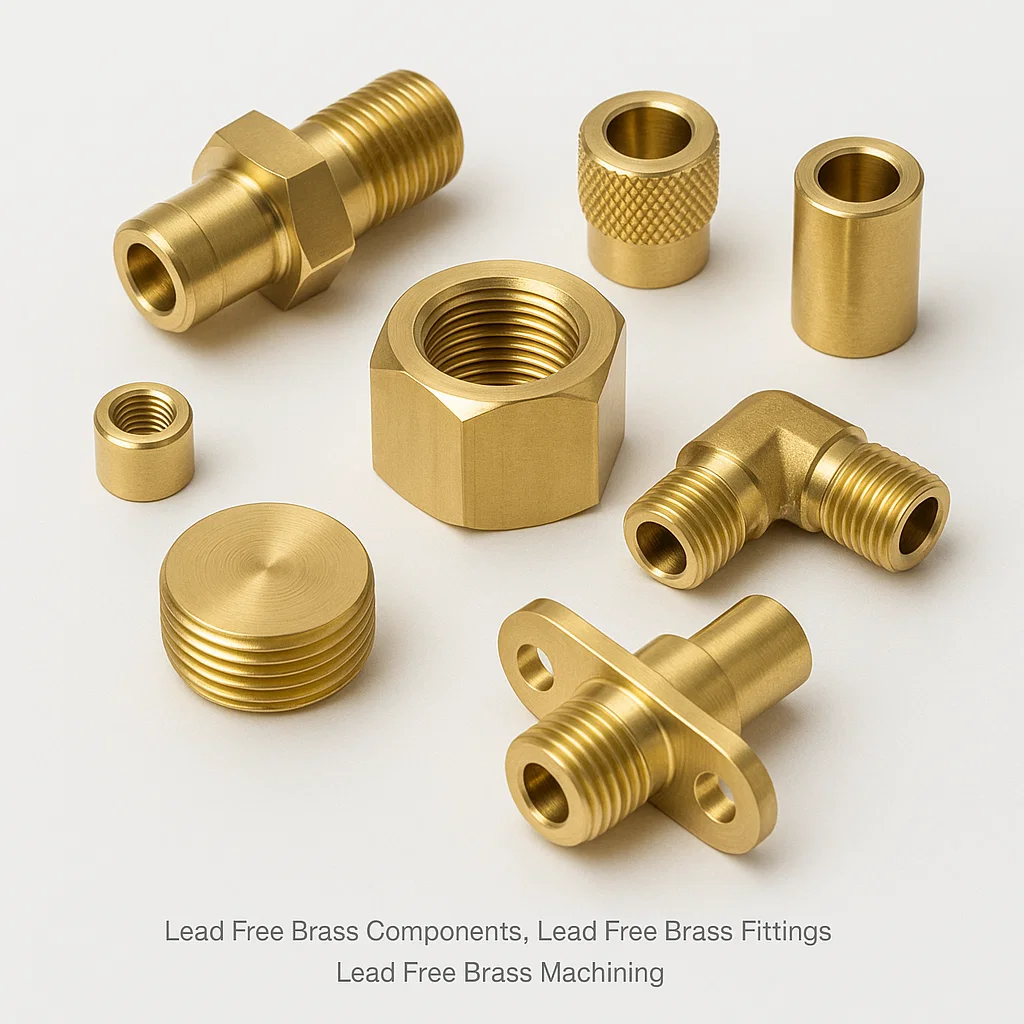
Lead Free Brass Parts and Lead Free Brass Fittings: Precision Manufactured Components for Global Applications
Comprehensive Overview of Lead Free Brass Manufacturing
We are one of the leading manufacturers and exporters of Lead Free Brass parts and Lead Free Brass fittings from India. We have been supplying precision engineered Lead Free Brass components to the world market for many decades. Our manufacturing facility in Jamnagar, India, combines traditional craftsmanship with advanced CNC machining technology to produce high-quality Lead Free Brass turned parts, machined components, and fittings that meet stringent international standards. Lead Free Brass has become the material of choice for potable water applications, plumbing systems, and food-grade equipment across North America, Europe, and other regulated markets where traditional leaded Brass alloys are restricted or prohibited. The elimination of Lead content addresses critical health concerns while maintaining the excellent machinability, corrosion resistance, and antimicrobial properties that make Brass alloys ideal for water distribution systems, valve components, pump parts, and sanitary fittings. Our three decades of experience in precision metal component manufacturing, combined with ISO 9001:2015, ISO 14001:2015, and ISO 45001:2018 certifications, ensures that every Lead Free Brass part leaving our facility meets exacting dimensional tolerances, surface finish requirements, and material composition standards. We specialize in both standard catalog items and custom-designed components, working closely with OEMs, distributors, and end-users to deliver solutions that optimize performance, cost-efficiency, and regulatory compliance in drinking water systems, beverage dispensing equipment, marine applications, and industrial fluid handling installations.
Lead Free Brass Parts: Precision Components for Compliant Applications
Lead Free Brass parts encompass a wide range of machined, turned, forged, and cast components manufactured from Copper-Zinc alloys with Lead content below regulatory thresholds established by legislation such as the United States Safe Drinking Water Act (SDWA), California AB1953, and Vermont Act 193. These regulations typically mandate that wetted surface Lead content must not exceed 0.25% weighted average, with most modern Lead Free Brass alloys maintaining Lead levels below 0.1% to provide safety margins. Our manufacturing capabilities span hot forging, cold forging, investment casting, sand casting, gravity die casting, CNC precision machining, Swiss-type automatic turning, multi-spindle screw machining, and secondary operations including thread rolling, knurling, broaching, and electrical discharge machining. The versatility of Lead Free Brass parts makes them indispensable across municipal water infrastructure, residential plumbing fixtures, commercial building systems, food processing equipment, brewery and winery installations, pharmaceutical manufacturing facilities, and marine fluid handling systems. Common Lead Free Brass parts produced at our facility include valve stems, pump impellers, manifold bodies, compression sleeves, insert fittings, hose barbs, nozzles, quick-connect couplers, backflow preventer components, meter housings, filter housings, thermostat bodies, and specialty fasteners. The material’s natural antimicrobial properties, dezincification resistance, and long-term dimensional stability make these parts suitable for continuous service in chlorinated water, brackish water, and mildly corrosive fluid environments with operating temperatures ranging from -40°F to 250°F (-40°C to 121°C).
Lead Free Brass Fittings: Critical Connectors for Potable Water Systems
Lead Free Brass fittings represent specialized pipe connection components designed specifically for drinking water distribution, ensuring safe fluid conveyance while providing reliable mechanical joints between pipes, valves, fixtures, and equipment. These fittings include compression fittings, push-to-connect fittings, flare fittings, threaded pipe fittings, barbed fittings, press fittings, and insert fittings manufactured to comply with NSF/ANSI 61 and NSF/ANSI 372 standards for drinking water system components. Our Lead Free Brass fitting production encompasses sizes from 1/8 inch to 4 inches nominal diameter, with thread configurations including NPT (National Pipe Thread), BSPT (British Standard Pipe Thread), metric threads, and proprietary connection systems specified by major plumbing fixture manufacturers. The manufacturing process begins with precision forging or bar stock selection, followed by CNC multi-axis machining to achieve complex internal passages, hexagonal wrench flats, and connection interfaces. Thread cutting operations employ form taps, roll taps, or thread milling to produce Class 2A external threads and Class 2B internal threads meeting ASME B1.20.1 specifications for taper pipe threads. Surface treatments applied to Lead Free Brass fittings include electroless nickel plating, chrome plating, brush nickel finish, and passivation treatments that enhance corrosion resistance while maintaining the low-Lead compliance required for potable water contact. Installation environments for these fittings span residential home plumbing, hotel and hospitality water systems, hospital medical gas and water distribution, school and university campus infrastructure, municipal water treatment plants, commercial kitchen equipment connections, beverage carbonation systems, ice machine installations, and irrigation system manifolds where reliable leak-free performance is essential.
Lead Free Brass Machining: Precision Manufacturing Technologies
Lead Free Brass machining encompasses the complete spectrum of subtractive manufacturing processes used to transform raw material forms including bar stock, rod, tube, plate, and near-net-shape forgings into finished precision components with tight dimensional tolerances and superior surface finishes. Our machining center is equipped with state-of-the-art CNC turning centers, multi-axis machining centers, Swiss-type automatic lathes, gang-style tooling machines, and conventional engine lathes capable of handling work piece diameters from 2mm to 200mm and lengths up to 500mm. The machinability characteristics of modern Lead Free Brass alloys like C36000 (Free-Cutting Brass with minimal Lead), Bismuth-bearing alloys, and Silicon-Brass formulations differ from traditional leaded grades, requiring optimized cutting parameters, tool geometries, and coolant strategies to achieve comparable productivity. Our machining engineers have developed proprietary speed and feed rate tables, insert grade selections, and chip-breaking strategies specifically for Lead Free Brass materials that maintain tool life while achieving surface finishes better than 32 microinches Ra and dimensional tolerances within ±0.0005 inches (±0.013mm) on critical features. Threading operations for Lead Free Brass components utilize single-point thread turning, thread milling, and thread rolling techniques to produce pipe threads, machine screw threads, and custom thread forms with thread class tolerances ranging from 1A/1B (loose fit) to 3A/3B (close fit) depending on application requirements. Drilling operations employ carbide drills, gun drills for deep holes, and specialized geometries for through-holes, blind holes, cross-drilling, and angled hole intersections common in manifold and valve body designs. Secondary machining operations including reaming, boring, counterboring, countersinking, chamfering, deburring, and surface grinding ensure that every machined feature meets print specifications before components proceed to quality inspection stations equipped with coordinate measuring machines, optical comparators, thread gauges, and surface roughness testers.
Lead Free Brass Turned Parts: High Volume Precision Components
Lead Free Brass turned parts constitute a major category of cylindrical components produced on CNC turning centers, automatic screw machines, and multi-spindle turning equipment where rotational symmetry enables efficient material removal and exceptional dimensional consistency across production runs. These turned parts include valve components, pump shafts, threaded rod ends, bearing bushings, spacers, standoffs, electrical terminals, connector pins, plumbing nipples, pipe plugs, and specialty fasteners used throughout water distribution, HVAC systems, automotive applications, and industrial equipment assemblies. Our CNC turning operations utilize live tooling capabilities that combine rotary cutting with Y-axis milling, cross-drilling, and complex contouring operations within a single machine cycle, minimizing part handling and improving geometric accuracy. Bar feeding systems enable lights-out manufacturing for high-volume orders, with automatic bar loaders delivering raw material to the machine spindle while scrap handling systems remove chips and cut-off slugs from the work envelope. The turning process sequence typically begins with facing operations to establish a reference surface, followed by rough turning to remove bulk material, finish turning to achieve final dimensions, threading operations for connection features, grooving for O-ring seats or snap ring grooves, and part-off operations that separate the finished component from the bar stock. Tool selection for Lead Free Brass turning operations favors positive rake angle geometries, sharp cutting edges, and coated carbide inserts that minimize built-up edge formation while maximizing surface finish quality. Turning speeds for Lead Free Brass alloys typically range from 400 to 1200 surface feet per minute depending on alloy composition, with feed rates between 0.004 and 0.020 inches per revolution producing optimal combinations of material removal rate, tool life, and surface quality. Quality control procedures for turned parts include 100% visual inspection, statistical process control monitoring of critical dimensions, and batch sampling for material composition verification, thread gauging, and surface finish measurement.
Brass Machined Parts Free of Lead: Engineered Solutions for Health-Conscious Markets
Brass machined parts free of Lead represent our commitment to manufacturing components that prioritize human health and environmental safety without compromising the mechanical properties, corrosion resistance, and manufacturing efficiency that traditional Brass alloys provide. The transition from leaded Brass formulations to Lead Free alternatives required significant research and development investment to identify substitute alloying elements that replicate the chip-breaking characteristics, cutting tool life, and surface finish qualities that made traditional Free-Cutting Brass the preferred material for high-volume screw machine production. Modern Lead Free Brass compositions incorporate elements such as Bismuth, Silicon, Tin, and proprietary combinations of minor alloying additions that improve machinability while maintaining Copper content between 57% and 90% and Zinc as the primary alloying element. Our Brass machined parts free of Lead production includes complex geometries such as multi-port manifolds, valve bodies with internal flow passages, pump housings with threaded connections, meter bodies with integrated mounting features, and specialty components requiring geometric dimensioning and tolerancing (GD&T) controls including true position, perpendicularity, flatness, and surface profile specifications. Manufacturing process validation ensures that every production run maintains consistent material properties, dimensional accuracy, and surface finish quality through first article inspection protocols, in-process quality checks at 15-minute intervals for critical features, and final inspection procedures that verify conformance to customer specifications. Heat treatment operations including stress relieving, annealing, and solution treatment may be applied to Brass machined parts free of Lead when residual stresses from machining operations must be minimized or when material softening facilitates subsequent forming operations such as tube flaring, end-forming, or swaging. Traceability systems track material certification from raw material suppliers through production operations to final packaging, ensuring complete documentation of alloy composition, heat lot numbers, and inspection results for customers requiring material test reports and certificates of conformance.
Brass CNC Machined Parts Lead Free: Advanced Manufacturing Excellence
Brass CNC machined parts Lead Free combine the precision of computer numerical control manufacturing technology with the health-safety benefits of low-Lead alloy compositions, delivering components that meet stringent dimensional tolerances while ensuring compliance with drinking water safety regulations worldwide. Our CNC machining department operates 3-axis vertical machining centers, 4-axis horizontal machining centers, 5-axis simultaneous machining centers, and turning centers equipped with sub-spindle transfer capabilities that enable complete machining of complex parts in a single setup. The programming expertise of our CNC department utilizes computer-aided manufacturing (CAM) software that generates optimized tool paths, minimizes non-cutting air time, and maximizes material removal rates while maintaining surface finish requirements and avoiding tool deflection on thin-wall features. Fixture design for Brass CNC machined parts Lead Free incorporates modular vise systems, custom soft jaws, vacuum workholding, and hydraulic clamping devices that provide secure part retention during high-speed machining operations without inducing workpiece deformation or leaving witness marks on finished surfaces. Tool management systems organize cutting tools by operation sequence, automatically measure tool lengths and diameters to compensate for thermal growth and wear, and track tool life cycles to ensure replacement before dimensional drift affects part quality. Lead Free Brass CNC machining operations achieve remarkable precision including hole-to-hole true position tolerances of ±0.001 inches (±0.025mm), flatness tolerances of 0.0005 inches per inch (0.0005:1), and surface finishes as fine as 16 microinches Ra on critical sealing surfaces. Complex features commonly produced in Brass CNC machined parts Lead Free include internal helical cooling passages, intersecting fluid galleries, tapered valve seats with precise cone angles, multi-start threads, interrupted threads, and sculptured surfaces requiring ball-nose end mill contouring operations. Post-machining operations available for Brass CNC machined parts Lead Free include ultrasonic cleaning to remove machining oils and metal fines, passivation treatments to enhance corrosion resistance, dimensional inspection using coordinate measuring machines with touch-probe and laser scanning capabilities, and serialization using dot peen marking, laser engraving, or ink-jet printing systems.
Material Grades and International Standards for Lead Free Brass
The selection of appropriate Lead Free Brass alloys depends on application requirements including mechanical strength, corrosion resistance, machinability, hot workability, and regulatory compliance with drinking water safety standards. Understanding the diverse nomenclature systems used globally helps customers specify materials correctly and enables manufacturers to source equivalent grades when primary specifications are unavailable.
Lead Free Brass Alloy Designations Across International Standards:
| Material Designation | Composition (%) | Standard | Key Characteristics | Typical Applications |
|---|---|---|---|---|
| C36000 (Low-Lead) | Cu 60-63, Zn Remainder, Pb <0.25 | ASTM B16 | Good machinability, moderate corrosion resistance | General purpose fittings, valve components |
| C46400 (Naval Brass) | Cu 59-62, Zn Remainder, Sn 0.5-1.0, Pb <0.09 | ASTM B21 | Excellent corrosion resistance, good strength | Marine hardware, pump shafts |
| C69300 (Silicon Red Brass) | Cu 81-85, Zn Remainder, Si 3.5-5.5, Pb <0.05 | ASTM B30 | Superior corrosion resistance, moderate machinability | Pump impellers, valve seats |
| C75200 (Nickel Silver) | Cu 63-67, Ni 16-19, Zn Remainder, Pb <0.1 | ASTM B122 | High strength, excellent corrosion resistance | Food service equipment, medical devices |
| CW511L (European) | Cu 57-59, Zn Remainder, Pb <0.1 | EN 12164 | EU compliant, good machinability | European market plumbing fittings |
| CuZn36Pb1.5As (DIN) | Cu 57-60, Zn Remainder, Pb <0.2, As 0.02-0.15 | DIN 17660 | Dezincification resistant | German standard water fittings |
| HPb59-1 (Chinese Lead Free) | Cu 57-60, Zn Remainder, Pb <0.3, Bi 0.8-1.5 | GB/T 5231 | Bismuth-enhanced machinability | Chinese domestic water systems |
| C3604BD (Japanese) | Cu 57-61, Zn Remainder, Pb <0.25, Bi 0.9-1.3 | JIS H3250 | Bismuth free-cutting grade | Japanese plumbing components |
| CW724R (Bismuth Brass) | Cu 58-60, Zn Remainder, Bi 0.8-1.9, Pb <0.09 | EN 12164 | Enhanced machinability with Bismuth | High-volume screw machine parts |
| Eco Brass® (Proprietary) | Cu 62-65, Zn Remainder, Si 1.8-2.5, Pb <0.05 | Multiple | Patented Silicon-enhanced formula | Premium plumbing fixtures |
| C87850 (Silicon Bronze) | Cu 94-96, Si 3.0-5.0, Zn 1-2, Pb <0.02 | ASTM B98 | Exceptional corrosion resistance | Seawater applications |
| CW509L (Hot Working) | Cu 57-60, Zn Remainder, Pb <0.2 | EN 12163 | Excellent hot forgeability | Hot forged valve bodies |
Indian Standards for Brass Materials:
IS 319 covers Brass rod, section, and wire specifications. IS 410 designates Brass sheet and strip requirements. IS 6912 specifically addresses Lead Free Brass for potable water applications conforming to IS 10500 drinking water standards.
Compliance Certifications:
NSF/ANSI 61 certification verifies that materials and products do not leach contaminants into drinking water above health-based limits. NSF/ANSI 372 specifically addresses Lead content restrictions for drinking water system components, requiring weighted average Lead content of wetted surfaces not to exceed 0.25%. California Proposition 65 compliance ensures materials meet stringent California consumer product safety standards. REACH regulation compliance for European markets ensures restricted substance content remains within acceptable limits. WRAS (Water Regulations Advisory Scheme) approval demonstrates United Kingdom drinking water compliance. ACS (Attestation de Conformité Sanitaire) provides French drinking water system component approval.
Manufacturing Processes for Lead Free Brass Components
Our comprehensive manufacturing capabilities encompass traditional metalworking techniques and advanced precision processes, ensuring optimal production methods for each component design and order quantity.
Hot Forging Operations: Raw material billets are heated to temperatures between 1200°F and 1500°F (650°C to 815°C) in gas-fired or induction furnaces before being formed in hydraulic forging presses or mechanical forging hammers. Hot forging produces near-net-shape components with superior grain structure, reduced machining requirements, and enhanced mechanical properties compared to machined-from-solid alternatives. Typical hot forged components include valve bodies, manifold blocks, and pump housings where complex external geometries justify forging die investment.
Cold Forging and Heading Operations: Room temperature metal forming processes including heading, upsetting, extrusion, and coining produce high-strength fasteners, electrical terminals, and connector components with work-hardened surface layers and excellent dimensional consistency. Progressive cold forming dies enable multi-station forming sequences that gradually transform wire or rod stock into complex shapes without material waste.
Investment Casting (Lost Wax Process): Complex internal passageways and thin-wall sections difficult to machine economically are produced through investment casting where wax patterns are coated with ceramic slurry, the wax is melted away, and molten Brass is poured into the resulting cavity. Investment castings achieve surface finishes of 125 microinches Ra and dimensional tolerances of ±0.005 inches per inch (±0.005:1) without secondary machining on non-critical features.
Sand Casting Operations: Large-volume components and prototype quantities are produced through green sand molding, no-bake sand systems, or shell molding processes that form cavities using sand-based molds. Sand casting accommodates component weights from several ounces to hundreds of pounds with economical tooling costs for low-volume production runs.
Gravity Die Casting (Permanent Mold): Reusable metal molds produce consistent castings with better dimensional accuracy and surface finish than sand casting, making gravity die casting ideal for medium-volume production runs of valve bodies, manifolds, and pump housings between 500 and 10,000 pieces annually.
CNC Precision Machining: Computer-controlled machine tools remove material through turning, milling, drilling, and grinding operations to achieve final dimensions with tolerances as tight as ±0.0002 inches (±0.005mm) on critical features. Multi-axis machining centers enable complex geometric features including compound angles, internal undercuts accessed through small openings, and sculptured surfaces requiring simultaneous 5-axis contouring.
Swiss-Type Automatic Turning: Guide bushing-supported turning operations enable production of small-diameter, high-length-to-diameter-ratio components with exceptional concentricity and surface finish. Swiss machines excel at producing precision shafts, pins, nozzles, and threaded studs from bar stock with diameters between 1/16 inch and 1-1/4 inches.
Multi-Spindle Screw Machining: High-production-volume components benefit from multi-spindle automatic screw machines that perform multiple operations simultaneously on 4, 6, or 8 work pieces, achieving production rates exceeding 100 parts per minute for simple geometries. Multi-spindle machining suits orders exceeding 50,000 pieces where amortized setup costs justify specialized tooling investment.
Thread Rolling Operations: Cold forming threads through rolling dies rather than cutting produces stronger threads with work-hardened surfaces and continuous grain flow, improving fatigue strength by 20% to 30% compared to cut threads. Thread rolling machines produce external threads on valve stems, studs, and fasteners with excellent thread class tolerances.
Knurling and Texturing: Rotary broaching tools and knurling wheels create diamond, straight, or custom surface textures on component exteriors to improve grip, enable press-fit assembly interference, or provide aesthetic appearance enhancement. Knurling operations are performed on CNC lathes or dedicated knurling machines.
Broaching Operations: Internal splines, keyways, and complex internal profiles are formed through broaching, where multi-tooth cutting tools progressively enlarge holes to create precise internal geometries. Broaching produces internal hexagonal, square, and custom-shaped holes with excellent surface finish and dimensional accuracy.
Grinding and Honing: Precision cylindrical grinding, surface grinding, and internal honing operations achieve extremely tight tolerances and surface finishes required for bearing surfaces, valve seats, and sealing interfaces. Grinding machines equipped with computer-controlled wheel dressing systems maintain consistent material removal rates and surface finish quality throughout production runs.
Machinery and Equipment Used in Lead Free Brass Manufacturing
Our manufacturing facility houses extensive equipment inventory representing significant capital investment in precision metalworking technology:
CNC Turning Centers: DMG MORI NLX series, Mazak Quick Turn series, Haas ST-series lathes with 12-station turrets, live tooling, sub-spindles, and bar feeders for automated production.
CNC Machining Centers: Makino vertical machining centers, Mazak horizontal machining centers, Haas VF-series vertical mills with 20-position automatic tool changers and through-spindle coolant delivery.
Swiss-Type Automatic Lathes: Citizen Cincom series, Star SR-series machines with guide bushing support, gang-style tooling, and automatic bar feeding systems.
Multi-Spindle Screw Machines: Davenport multi-spindle automatics, New Britain six-spindle machines configured for high-volume production with automatic tool indexing.
Forging Equipment: Erie mechanical forging presses, hydraulic forging presses with 500-ton to 2000-ton capacity, induction heating systems for billet preparation.
Investment Casting Facilities: Wax injection machines, automated shell building systems, vacuum dewaxing furnaces, induction melting furnaces with precise temperature control.
Quality Inspection Equipment: Mitutoyo coordinate measuring machines with touch-probe and laser scanning, Keyence optical measuring systems, Mitutoyo surface roughness testers, Mitutoyo hardness testers, X-ray fluorescence spectrometers for material composition verification.
Thread Inspection Equipment: Thread ring gauges, thread plug gauges, optical comparators with thread profile overlays, laser thread measurement systems.
Surface Treatment Equipment: Electroplating tanks with rectifiers, electroless plating systems, passivation processing lines, ultrasonic cleaning systems.
Typical Lead Free Brass Parts Produced at Our Facility
Our extensive production experience encompasses thousands of unique component designs across diverse application categories:
Plumbing and Water Distribution Components: Compression fittings with brass ferrules, push-to-connect fittings with internal gripping mechanisms, flare fittings for refrigeration systems, threaded pipe nipples, reducing bushings, pipe plugs, pipe caps, unions, couplings, adapters, tees, elbows, crosses, manifolds with multiple outlets, backflow preventer components, water meter housings, valve bodies for ball valves, valve bodies for gate valves, valve stems with ACME threads, check valve components, pressure reducing valve internals, mixing valve cartridges, thermostatic valve elements, expansion tank connections, radiator valves, balancing valve components.
HVAC and Refrigeration Parts: Flare fittings for refrigerant lines, brazed fittings, access valves, service valves, refrigerant distributor tubes, capillary tube fittings, sight glass housings, filter drier connections, accumulator fittings, heat exchanger connections, expansion valve components.
Pump and Valve Components: Pump impellers, pump shafts, wear rings, mechanical seal housings, gland packings, valve seats, valve discs, valve bonnets, actuator connections, gauge connections, drain plugs, vent plugs, stuffing box components.
Electrical and Electronics Parts: Electrical terminals, bus bars, grounding connectors, cable glands, cord grips, connector pins, terminal blocks, switch components, relay housings, transformer bushings.
Industrial Automation Components: Pneumatic fittings, quick-disconnect couplers, hose barbs, manifolds for air distribution, regulator bodies, lubricator components, air cylinder end caps, solenoid valve housings.
Marine Hardware: Through-hull fittings, deck drains, scuppers, seacocks, marine valves, propeller shaft components, rudder bearings, cooling system components.
Automotive Applications: Fuel system components, brake system fittings, transmission cooler connections, hydraulic system components, oil cooler fittings.
Medical and Laboratory Equipment: Valve components for medical gas systems, surgical instrument components, laboratory equipment fittings, pharmaceutical processing connections.
Food and Beverage Equipment: Beer tap components, wine dispenser parts, carbonation system fittings, coffee machine components, soda fountain parts, commercial kitchen equipment connections.
Technical Specifications and Tolerances
Our manufacturing capabilities deliver precision components meeting exacting dimensional requirements:
Standard Dimensional Tolerances (unless otherwise specified):
- Turned diameters: ±0.002 inches (±0.05mm)
- Machined features: ±0.005 inches (±0.13mm)
- Hole locations: ±0.005 inches (±0.13mm)
- Thread pitch diameter tolerance: Class 2A/2B per ASME B1.20.1
- Flatness: 0.002 inches per inch (0.002:1)
- Perpendicularity: 0.003 inches (0.076mm)
- Concentricity: 0.002 inches TIR (0.05mm)
- Surface finish: 63 microinches Ra (1.6 micrometers Ra) standard, 32 microinches Ra (0.8 micrometers Ra) achievable on request
Tighter Precision Tolerances Available:
- Turned diameters: ±0.0002 inches (±0.005mm)
- Ground surfaces: ±0.0001 inches (±0.0025mm)
- True position: ±0.001 inches (±0.025mm)
- Surface finish: 16 microinches Ra (0.4 micrometers Ra)
- Roundness: 0.0001 inches (0.0025mm)
Thread Specifications:
- NPT threads per ASME B1.20.1
- BSPT threads per BS 21 and ISO 7/1
- Metric threads per ISO 68-1
- Machine screw threads per ASME B1.1
- Custom thread forms to customer specifications
Material Property Requirements:
- Tensile strength: 45,000 to 70,000 psi depending on alloy
- Yield strength: 15,000 to 40,000 psi depending on alloy
- Elongation: 15% to 55% depending on alloy and temper
- Hardness: 50 to 95 HRB (Rockwell B scale)
- Lead content verification: XRF testing to verify <0.25% weighted average
- Corrosion resistance: 500+ hour salt spray testing per ASTM B117
Surface Finishes and Plating Options
Surface treatments enhance corrosion resistance, improve appearance, and provide specialized functional properties:
Electroplating Finishes:
- Nickel Plating: Bright nickel, satin nickel, or electroless nickel deposits ranging from 0.0002 to 0.001 inches thick providing excellent corrosion resistance and attractive appearance. Electroless nickel offers uniform thickness on complex geometries and superior wear resistance.
- Chrome Plating: Decorative chrome over nickel undercoat provides brilliant reflective finish for plumbing fixtures and architectural hardware with hardness exceeding 65 HRC.
- Tin Plating: Matte or bright tin deposits prevent tarnishing and provide excellent solderability for electrical connections with deposits 0.0001 to 0.0005 inches thick.
- Zinc Plating: Yellow zinc chromate, clear zinc, or black zinc provide economical corrosion protection for industrial components with 96-hour salt spray resistance.
Chemical Treatments:
- Passivation: Chemical treatment removes free iron and creates passive oxide layer that enhances corrosion resistance without adding coating thickness.
- Chromate Conversion Coating: Chemical conversion coating provides additional corrosion protection and paint adhesion base for components requiring subsequent coating.
Mechanical Finishes:
- Tumbling and Deburring: Mass finishing operations using ceramic media remove burrs, round sharp edges, and produce uniform surface appearance.
- Polishing: Progressive polishing with increasingly fine abrasive compounds produces mirror-bright reflective surfaces for decorative applications.
- Brush Finishing: Rotating abrasive brushes create directional grain patterns for satin or matte appearance.
- Bead Blasting: Glass bead or ceramic bead impact creates uniform matte texture and stress relieves surface layers.
Protective Coatings:
- Clear Lacquer: Organic coating preserves natural Brass color while preventing tarnishing during storage and installation.
- Powder Coating: Electrostatic powder application followed by heat curing produces durable colored finishes resistant to chipping and UV degradation.
Industries and Applications for Lead Free Brass Components
Our Lead Free Brass parts and fittings serve critical functions across numerous industries worldwide:
Municipal Water Infrastructure: Water treatment plants, distribution systems, pumping stations, storage tanks, and meter installations rely on Lead Free Brass components ensuring safe drinking water delivery to communities. Components include meter housings, valve assemblies, manifold systems, and connection fittings that must withstand continuous service exposure to chlorinated water while maintaining zero Lead leaching over decades of service life.
Residential Plumbing Systems: Single-family homes, multi-family residential buildings, and mixed-use developments incorporate Lead Free Brass fittings, valve components, and fixture connections throughout hot and cold water distribution, ensuring compliance with building codes and protecting occupant health. Applications include faucet components, shower valve assemblies, toilet fill valves, water heater connections, and point-of-use filtration system fittings.
Commercial Buildings: Office buildings, retail centers, hotels, and institutional facilities utilize Lead Free Brass components in water distribution, fire suppression systems, HVAC equipment, and process water systems serving restaurants, laundries, and specialized equipment. The antimicrobial properties of Copper alloys provide additional protection against bacterial growth in building water systems.
Healthcare Facilities: Hospitals, medical clinics, dental offices, and pharmaceutical manufacturing facilities require ultra-pure water systems with Lead Free Brass components meeting stringent medical gas standards, USP water specifications, and infection control protocols. Applications include medical gas pipeline components, laboratory water systems, sterilizer connections, and surgical instrument cleaning systems.
Food and Beverage Processing: Breweries, wineries, soft drink bottling plants, dairy processing facilities, and commercial food preparation operations utilize Lead Free Brass fittings, valve components, and process equipment connections approved for direct food contact. The corrosion resistance of Lead Free Brass performs reliably in acidic beverages, carbonated products, and hot water cleaning cycles.
Marine Applications: Boats, yachts, commercial vessels, and offshore platforms incorporate Lead Free Brass components in freshwater systems, sanitation systems, and selected seawater applications where Silicon Bronze or Naval Brass grades provide necessary corrosion resistance. Marine-grade Lead Free Brass resists dezincification in brackish water environments common in coastal marinas.
Industrial Manufacturing: Chemical processing, pharmaceutical production, semiconductor fabrication, and general manufacturing operations specify Lead Free Brass components for process fluid handling, compressed air distribution, hydraulic systems, and cooling water circuits where material compatibility and reliability are critical.
HVAC and Refrigeration: Heating, ventilation, air conditioning, and refrigeration systems throughout residential, commercial, and industrial installations rely on Lead Free Brass fittings, valve components, and heat exchanger connections for refrigerant lines, chilled water systems, and condensate drainage.
Agriculture and Irrigation: Farm irrigation systems, greenhouse operations, aquaculture facilities, and municipal landscape irrigation utilize Lead Free Brass manifolds, valve assemblies, and connection fittings where potable water sources feed distribution systems and regulatory compliance prevents groundwater contamination.
Standard Production Timeline and Turnaround Time
Our manufacturing planning and production scheduling deliver predictable lead times aligned with customer project requirements:
Standard Production Timeline: 4-6 weeks from order confirmation
This timeline encompasses the complete manufacturing cycle including:
- Raw material procurement and incoming inspection (3-5 business days)
- Production planning and CNC programming (2-3 business days)
- Manufacturing operations including machining, forming, and assembly (2-3 weeks)
- Surface treatment and finishing operations (3-5 business days)
- Quality inspection and testing (2-3 business days)
- Packaging and shipping preparation (1-2 business days)
Expedited Production Available: Rush orders requiring faster delivery can be accommodated through premium scheduling with 2-3 week production cycles for orders up to 5,000 pieces, subject to manufacturing capacity availability and material stock levels.
Sample and Prototype Quantities: First article samples and prototype quantities typically ship within 7-10 business days, enabling rapid design validation and customer approval before committing to production volumes.
Large Volume Production Runs: Orders exceeding 50,000 pieces may require extended lead times based on raw material procurement cycles and production capacity allocation, with delivery schedules coordinated to support customer inventory management and just-in-time manufacturing requirements.
Flexible Scheduling Options: We understand that customer production schedules change, and we maintain flexibility to adjust delivery schedules, split shipments, and coordinate staged deliveries that align with customer installation schedules, project milestones, and inventory management strategies.
Performance Metrics and Quality Standards
Our commitment to quality excellence ensures consistent product performance meeting stringent application requirements:
Dimensional Inspection Results: Statistical process control monitoring demonstrates that 99.7% of critical dimensions fall within specified tolerances during normal production runs, with Cpk (process capability index) values consistently exceeding 1.33 on controlled features.
Material Composition Verification: X-ray fluorescence (XRF) testing confirms Lead content below 0.25% weighted average on wetted surfaces, with typical results showing Lead levels below 0.1% on modern Lead Free Brass alloys, providing substantial safety margin above regulatory requirements.
Pressure Testing Performance: Threaded fittings and valve bodies undergo hydrostatic pressure testing to 1.5 times rated working pressure, demonstrating leak-free performance at test pressures ranging from 150 psi to 600 psi depending on component design and size.
Corrosion Resistance Testing: Accelerated salt spray testing per ASTM B117 demonstrates that Lead Free Brass components maintain integrity through 500+ hour exposures, with nickel-plated components exceeding 1,000 hours without base metal corrosion.
Thread Quality Verification: Thread gauges verify that NPT threads meet L1 (hand-tight engagement) and L2 (wrench-tight engagement) length requirements per ASME B1.20.1, ensuring reliable sealing performance with PTFE tape or pipe thread sealant.
Surface Finish Measurements: Contact profilometer measurements document surface roughness values, with standard production finishes averaging 32-63 microinches Ra and precision-ground surfaces achieving 16 microinches Ra or better.
Hardness Testing: Rockwell hardness testing confirms material properties consistent with specified alloy grades, with typical hardness values ranging from 60 to 85 HRB for machined components and 50 to 70 HRB for hot-worked fittings.
Cleanliness Standards: Ultrasonic cleaning and aqueous degreasing operations remove machining oils, metal fines, and contamination before packaging, with cleanliness verification through visual inspection under magnification and wipe testing protocols.
Why Choose Conex Metals for Your Lead Free Brass Components
Our three decades of manufacturing excellence and global market experience position us as the preferred supplier for customers requiring reliable Lead Free Brass parts and fittings:
Unmatched Manufacturing Flexibility: Unlike rigid production facilities, we adapt to your needs. Whether you require 100 prototype samples or 100,000 production pieces, our scalable manufacturing infrastructure handles orders of any size without minimum order quantity restrictions that burden smaller customers or maximum capacity limits that disappoint larger accounts. Our equipment diversity spanning CNC precision machining, Swiss-type automatic turning, multi-spindle screw machines, and forging operations ensures we select the optimal manufacturing process for your component geometry, order quantity, and cost targets.
Engineering Support Throughout Your Project: Our engineering team doesn’t just manufacture your prints—we partner with you to optimize designs for manufacturability, cost-efficiency, and performance. Design review services identify opportunities to reduce machining time, minimize material waste, consolidate assembly operations, and improve product reliability. Our engineers propose alternative manufacturing methods, suggest material grade optimizations, and provide design-for-manufacturing recommendations that lower your total cost of ownership while enhancing component quality. Technical drawing modifications, tolerance rationalization, and geometric dimensioning and tolerancing assistance help you specify exactly what you need without over-specifying features that increase costs unnecessarily.
Responsive Communication Across Time Zones: Operating from India with a customer base spanning North America, Europe, Australia, and Asia requires exceptional communication discipline. Our team responds to email inquiries within 4 hours during business days, provides detailed quotations within 24 hours of receiving RFQ packages, and maintains dedicated customer service representatives familiar with your account history and project requirements. Video conferencing capabilities enable face-to-face design reviews, quality discussions, and production status meetings that build relationships despite geographic distances.
Three Decades of Global Export Experience: Since our founding, we’ve navigated the complexities of international trade including material certification requirements, export documentation, customs compliance, freight forwarding coordination, and duty minimization strategies. This experience ensures your components arrive on schedule with proper commercial invoices, certificates of origin, material test reports, and inspection documentation required by your receiving facilities. We understand FDA import requirements for food-contact materials, EPA compliance for drinking water components, and specialized certifications demanded by maritime classification societies, pressure vessel codes, and industry-specific standards.
Customized Packaging and Branding Solutions: Your brand identity matters. We offer private labeling services that affix your company logo, part numbers, and handling instructions to cartons, poly bags, and component labels, enabling you to receive inventory ready for redistribution without repackaging labor. Custom packaging configurations protect fragile components during international shipping while optimizing freight cube utilization to minimize transportation costs. Returnable container programs for high-volume repeat orders reduce packaging waste and support your sustainability initiatives.
Quality Systems and Certification Portfolio: ISO 9001:2015 certification demonstrates our commitment to quality management systems, documented procedures, and continuous improvement methodologies. ISO 14001:2015 environmental management certification ensures sustainable manufacturing practices, waste minimization, and environmental compliance. ISO 45001:2018 occupational health and safety certification protects our workforce and demonstrates operational excellence. NSF/ANSI 61 and NSF/ANSI 372 certifications for Lead Free Brass materials provide third-party verification of drinking water safety compliance required by major customers and regulatory authorities.
Transparent Pricing Without Hidden Charges: Our quotations include all manufacturing costs, surface treatments, packaging expenses, and domestic transportation to international shipping ports. No surprise charges appear when your shipment arrives. We provide detailed cost breakdowns separating material costs, processing costs, and tooling investments, enabling informed decision-making about design alternatives and volume commitments. Long-term pricing agreements for multi-year programs provide budget predictability and inflation protection for customers seeking strategic supplier relationships.
Production Capacity and Scalability: Our 50,000 square foot manufacturing facility operates two shifts daily with capacity expansion available through third-shift operations and weekend production runs during peak demand periods. Equipment redundancy ensures that machine breakdowns don’t halt production, with backup machines available for critical operations. Our supplier network provides surge capacity access when customer orders exceed our internal capabilities, enabling us to commit to delivery schedules with confidence.
Continuous Investment in Technology: We reinvest profits into manufacturing technology upgrades, quality inspection equipment, and workforce training that improve productivity, reduce defect rates, and expand our capabilities to serve evolving customer requirements. Recent capital investments include 5-axis machining centers enabling complex geometric features, coordinate measuring machines with optical scanning for dimensional verification, and XRF spectrometers for rapid material composition analysis.
Packaging and Shipping Capabilities
Proper packaging protects your components during international transportation while optimizing logistics costs:
Standard Packaging Options:
- Polyethylene bags with desiccant packets for moisture protection
- Corrugated cartons with foam cushioning for fragile components
- Wooden crates for heavy castings and large assemblies
- Palletized shipments with stretch wrap and banding for stability
- Export-grade packaging meeting ISPM 15 phytosanitary standards
Custom Packaging Services:
- Private label printing with customer logos and part numbers
- Color-coded packaging for inventory management and quality segregation
- Sequential serialization for traceability requirements
- Compartmentalized cartons preventing component contact and surface damage
- Returnable container programs reducing packaging waste
Shipping and Logistics:
- International freight forwarding through established logistics partners
- Multiple shipping options including air freight, ocean freight, and express courier
- Consolidated shipments combining multiple orders reducing per-piece freight costs
- Delivered duty paid (DDP) terms available eliminating customs clearance complexity
- Real-time shipment tracking and proactive delivery status communication
Documentation Package:
- Commercial invoice with harmonized tariff codes
- Packing list with piece counts and net weights
- Certificate of origin (preferential or non-preferential)
- Material test reports with composition verification
- Certificate of conformance to customer specifications
- Inspection reports with dimensional measurement data
- Export licenses and compliance certifications as required
Comprehensive Technical Questions and Answers
Q1: What makes Lead Free Brass different from traditional Free-Cutting Brass alloys used historically in plumbing components? Lead Free Brass eliminates or dramatically reduces Lead content to below 0.25% weighted average on wetted surfaces, addressing health concerns about Lead leaching into drinking water. Traditional Free-Cutting Brass (C36000) contained 2.5% to 3.7% Lead to improve machinability, but this is now prohibited in potable water applications across North America and increasingly worldwide.
Q2: How does removing Lead from Brass affect the machinability and manufacturing costs of components? Lead acts as a chip-breaker during machining operations, reducing cutting forces and improving tool life. Lead Free alternatives incorporate Bismuth, Silicon, or other elements to replicate these benefits, though cutting speeds may decrease 10-20% and tool life may reduce 15-30% compared to traditional leaded grades, potentially increasing manufacturing costs 8-15% depending on component complexity and production volume.
Q3: Which Lead Free Brass alloy should I specify for my application if I need maximum corrosion resistance in chlorinated drinking water? Silicon Red Brass (C69300) or Naval Brass grades (C46400) offer superior dezincification resistance and corrosion performance in chlorinated water environments. These alloys contain higher Copper content and beneficial alloying elements like Silicon or Tin that form protective oxide layers preventing selective leaching of Zinc from the alloy matrix.
Q4: Can Lead Free Brass components be used in hot water recirculation systems operating continuously at 180°F (82°C)? Yes, Lead Free Brass maintains mechanical properties and corrosion resistance at hot water temperatures up to 250°F (121°C). However, specify alloys with dezincification resistance for continuous hot water exposure, and ensure system water chemistry maintains pH between 6.5 and 8.5 with chloride content below 200 ppm for optimal service life.
Q5: What surface finish is recommended for Lead Free Brass fittings used in residential plumbing installations? Electroless nickel plating or chrome plating over nickel provides attractive appearance, excellent corrosion resistance, and prevents tarnishing during storage and service. Standard as-machined surface finish (63 microinches Ra) is acceptable for industrial applications where appearance is secondary to function, while polished or plated finishes suit exposed architectural applications.
Q6: How tight can dimensional tolerances be held on CNC machined Lead Free Brass components? Standard CNC turning operations achieve ±0.002 inch tolerances on diameters, while precision grinding operations achieve ±0.0001 inch tolerances on critical features. Geometric tolerances including true position, perpendicularity, and concentricity can be controlled to ±0.001 inch when component design justifies precision machining operations and tighter quality control procedures.
Q7: What thread form and class of fit should I specify for NPT pipe threads on Lead Free Brass fittings? NPT (National Pipe Taper) threads per ASME B1.20.1 with Class 2A external threads and Class 2B internal threads provide standard pipe thread engagement. These threads seal through interference fit and require PTFE tape or pipe thread sealant compound for leak-free joints at system pressures up to 150 psi for residential and 300 psi for industrial applications.
Q8: Can you produce Lead Free Brass components with internal cross-drilled passages for manifold applications? Yes, our CNC machining centers utilize deep hole drilling, gun drilling, and right-angle drilling operations to produce complex internal passages. Design considerations include minimum hole diameter 0.125 inch, maximum depth-to-diameter ratio 10:1 for standard drills, and intersection angles greater than 30 degrees to prevent drill deflection and ensure proper hole breakthrough.
Q9: What minimum wall thickness should be maintained in Lead Free Brass valve bodies to withstand 200 psi working pressure? Minimum wall thickness calculations depend on component size, pressure rating, and safety factor. As a general guideline for Brass alloys with 50,000 psi tensile strength, maintain minimum wall thickness of 0.100 inch for 1-inch diameter components, scaling proportionally for larger sizes. Pressure testing to 1.5 times working pressure validates design adequacy before production release.
Q10: How do you ensure Lead content compliance when sourcing raw materials from multiple suppliers? Every material lot receives incoming inspection including XRF analysis verifying Lead content below specified limits. Material certifications from mill suppliers provide traceability to heat lot numbers, and we maintain material segregation throughout production preventing cross-contamination between Lead Free and traditional Brass grades. Finished component testing provides final verification before shipment.
Q11: What heat treatment processes can be applied to Lead Free Brass components to optimize mechanical properties? Stress relieving at 350°F to 500°F (175°C to 260°C) for 1-2 hours removes machining-induced residual stresses. Annealing at 800°F to 1200°F (425°C to 650°C) softens work-hardened material enabling subsequent forming operations. Solution treatment followed by cold working produces optimal strength-ductility combinations for specific applications requiring enhanced mechanical properties.
Q12: Can Lead Free Brass fittings be brazed or soldered using standard joining techniques? Yes, Lead Free Brass components are readily joined using silver brazing alloys (BAg), Copper-Phosphorus brazing alloys (BCuP), or Lead Free solders (Tin-Silver-Copper compositions). Surface preparation through mechanical abrasion or chemical cleaning removes oxides ensuring sound joints. Flux selection depends on base metal composition and joining process temperature requirements.
Q13: What inspection and testing documentation do you provide with shipments for traceability purposes? Standard documentation includes material test reports showing alloy composition analysis, certificates of conformance stating compliance with drawing specifications, dimensional inspection reports documenting critical feature measurements, and pressure test records if applicable. Additional certifications available include third-party material certifications, hardness test results, metallurgical analysis, and photographic inspection documentation.
Q14: How does your facility handle production of components requiring multiple manufacturing operations across different processes? Our integrated facility encompasses machining, forging, casting, and finishing operations under one roof, eliminating transportation delays and coordination complexity between subcontractors. Work-in-process tracking systems monitor components through each operation, and production planning software optimizes workflow routing minimizing queue time between manufacturing stages.
Q15: What design features should be avoided when specifying Lead Free Brass components to minimize manufacturing costs? Avoid extremely deep pockets with small tool access (depth greater than 5 times width), very tight internal corner radii requiring small diameter end mills, interrupted threads requiring complex CNC programming, and surface finish requirements tighter than 32 microinches Ra on non-critical features. Providing generous machining access, standard thread forms, and rational tolerance specifications significantly reduce manufacturing complexity and costs.
Material Property Tables
Understanding material properties enables informed alloy selection for specific operating conditions:
Mechanical Properties of Common Lead Free Brass Alloys
| Property | C36000 (Low-Lead) | C46400 (Naval) | C69300 (Si-Brass) | Units |
|---|---|---|---|---|
| Tensile Strength | 49,000 | 55,000 | 60,000 | psi |
| Yield Strength | 20,000 | 25,000 | 28,000 | psi |
| Elongation | 30% | 40% | 35% | % in 2″ |
| Hardness | 60 HRB | 70 HRB | 75 HRB | Rockwell B |
| Modulus of Elasticity | 15,000,000 | 16,000,000 | 17,000,000 | psi |
| Shear Strength | 32,000 | 37,000 | 40,000 | psi |
| Fatigue Strength | 16,000 | 20,000 | 22,000 | psi |
Physical Properties of Lead Free Brass
| Property | Value | Units |
|---|---|---|
| Density | 0.304 – 0.308 | lb/in³ |
| Melting Point | 1650 – 1750 | °F |
| Thermal Conductivity | 70 – 90 | BTU/(hr·ft·°F) |
| Coefficient of Thermal Expansion | 11.1 – 11.6 | µin/(in·°F) |
| Electrical Conductivity | 25% – 30% IACS | % |
| Specific Heat | 0.09 | BTU/(lb·°F) |
Corrosion Resistance Ratings
| Environment | C36000 | C46400 | C69300 | Rating Scale |
|---|---|---|---|---|
| Fresh Water | B | A | A | A=Excellent, B=Good |
| Salt Water | C | B | A | C=Fair, D=Poor |
| Chlorinated Water | B | A | A | Based on long-term |
| Mild Acids | C | B | B | exposure testing |
| Mild Alkalis | B | B | A | – |
| Organic Solvents | A | A | A | – |
Dimensional Reference Chart for Common Lead Free Brass Fittings
Understanding standard fitting dimensions assists design integration and installation planning:
Compression Fitting Dimensions (Fractional Sizes)
| Nominal Size | Thread Size | Overall Length | Hex Width | Ferrule OD | Weight |
|---|---|---|---|---|---|
| 1/4″ | 7/16″-20 | 1.25″ | 9/16″ | 0.375″ | 0.3 oz |
| 3/8″ | 9/16″-18 | 1.38″ | 11/16″ | 0.500″ | 0.5 oz |
| 1/2″ | 3/4″-16 | 1.50″ | 7/8″ | 0.625″ | 0.8 oz |
| 5/8″ | 7/8″-14 | 1.75″ | 1-1/16″ | 0.750″ | 1.2 oz |
| 3/4″ | 1-1/16″-12 | 2.00″ | 1-1/4″ | 0.875″ | 1.8 oz |
| 1″ | 1-5/16″-12 | 2.50″ | 1-9/16″ | 1.125″ | 3.2 oz |
Threaded Pipe Fitting Dimensions (NPT)
| Nominal Size | Thread Spec | Overall Length | Hex Width | Bore Diameter | Weight |
|---|---|---|---|---|---|
| 1/8″ | 1/8″-27 NPT | 0.75″ | 7/16″ | 0.180″ | 0.2 oz |
| 1/4″ | 1/4″-18 NPT | 1.00″ | 9/16″ | 0.280″ | 0.4 oz |
| 3/8″ | 3/8″-18 NPT | 1.12″ | 11/16″ | 0.400″ | 0.7 oz |
| 1/2″ | 1/2″-14 NPT | 1.38″ | 7/8″ | 0.530″ | 1.3 oz |
| 3/4″ | 3/4″-14 NPT | 1.62″ | 1-1/16″ | 0.750″ | 2.4 oz |
| 1″ | 1″-11.5 NPT | 2.00″ | 1-5/16″ | 1.000″ | 4.2 oz |
| 1-1/4″ | 1-1/4″-11.5 NPT | 2.25″ | 1-11/16″ | 1.280″ | 6.8 oz |
| 1-1/2″ | 1-1/2″-11.5 NPT | 2.50″ | 1-7/8″ | 1.530″ | 9.5 oz |
| 2″ | 2″-11.5 NPT | 3.00″ | 2-3/8″ | 2.000″ | 16.0 oz |
Customer Testimonials
James Morrison, Procurement Manager, Portland, Oregon, USA: “We’ve partnered with Conex Metals for Lead Free Brass fittings over the past eight years and have been consistently impressed with their quality and reliability. Their engineering team helped us optimize several custom valve body designs, reducing our manufacturing costs by 22% while improving pressure testing pass rates to 99.8%. Communication is outstanding despite the time zone difference—questions emailed in the evening receive detailed technical responses by morning. s.”
Sarah Campbell, Technical Director, Reading, United Kingdom: “This company has become our preferred source for Lead Free Brass machined parts serving the UK water industry. Their understanding of British Standards, WRAS approval requirements, and European REACH compliance eliminated the technical translation challenges we experienced with other Asian suppliers.”
Glossary of Technical Terms
Antimicrobial Properties: The natural ability of Copper alloys including Brass to inhibit bacterial growth on contact surfaces through ion release mechanisms that disrupt cellular function, providing passive sanitation benefits in water distribution systems.
ASME B1.20.1: American Society of Mechanical Engineers standard specifying dimensions, tolerances, and gauging requirements for pipe threads including NPT (National Pipe Taper) and NPSM (National Pipe Straight Mechanical) thread forms.
Dezincification: A corrosion mechanism affecting Brass alloys where Zinc preferentially leaches from the alloy matrix leaving porous Copper structure with reduced mechanical strength. Dezincification-resistant alloys incorporate alloying elements or microstructural modifications preventing this failure mode.
Free-Cutting Brass: Brass alloys optimized for high-speed machining operations through addition of chip-breaking elements (historically Lead, now Bismuth or Silicon in Lead Free versions) that improve surface finish, reduce tool wear, and increase production rates.
Geometric Dimensioning and Tolerancing (GD&T): Symbolic language used on engineering drawings to specify allowable geometric variations in feature location, orientation, form, and profile using internationally standardized symbols and modifiers.
Hot Forging: Metal forming process where heated workpieces are compressed in dies to achieve net or near-net component shapes with improved grain flow, mechanical properties, and reduced machining requirements compared to machining from bar stock.
ISO 9001:2015: International quality management system standard establishing requirements for documented processes, management responsibility, resource management, product realization, measurement, analysis, and continuous improvement.
Machinability: The relative ease with which a material can be cut using machine tools, influenced by factors including chip formation characteristics, cutting forces required, tool wear rates, and achievable surface finishes.
NSF/ANSI 61: Standard for drinking water system components establishing health effects testing requirements and maximum contaminant level limits for materials in contact with potable water.
NSF/ANSI 372: Standard specifically addressing Lead content restrictions for drinking water system components, requiring weighted average Lead content not exceeding 0.25% on wetted surfaces.
Potable Water: Water safe for human consumption meeting drinking water quality standards established by regulatory authorities including EPA (United States), WHO (World Health Organization), and local jurisdictions.
Rockwell Hardness: Measurement of material resistance to indentation using standardized indenters and load applications, with multiple scales (HRB for softer materials, HRC for hardened materials) providing comparative hardness values.
Safe Drinking Water Act (SDWA): United States federal legislation establishing national standards for drinking water quality, including restrictions on Lead content in plumbing materials and fixtures.
Surface Roughness (Ra): Average deviation of surface profile from mean centerline expressed in microinches or micrometers, with lower values indicating smoother finishes suitable for sealing surfaces and aesthetic applications.
Swiss-Type Machining: Precision turning process using guide bushing support close to cutting zone enabling high-aspect-ratio parts (length-to-diameter ratios exceeding 10:1) with excellent concentricity and surface finish.
True Position: Geometric tolerance specifying allowable deviation of feature location from theoretically exact position, with cylindrical tolerance zone defined by diameter value preceded by diameter symbol in GD&T callouts.
Wetted Surface: Component surfaces in direct contact with fluid conveyed through pipe, fitting, or valve assembly, requiring Lead content compliance for potable water applications.
X-Ray Fluorescence (XRF): Non-destructive analytical technique using X-ray excitation to determine elemental composition, commonly employed for rapid Lead content verification in Brass components.
Related Parts:
Lead Free Brass components, Lead Free Brass fittings suppliers, Lead Free Brass machining services, Lead Free Brass parts manufacturer, Lead Free Brass CNC machining, Lead Free Brass turned parts, Lead Free Brass valve components, Lead Free Brass plumbing fittings, NSF certified Brass fittings, potable water Brass components, drinking water safe Brass parts, dezincification resistant Brass, Silicon Brass components, Bismuth Brass parts, C36000 low Lead Brass, Naval Brass Lead Free, compression fitting manufacturer, NPT threaded Brass fittings, BSPT Brass fittings, Brass manifold components, Brass pump parts Lead Free, Brass valve stems Lead Free, custom Brass machining, precision Brass turning, CNC Brass parts India, Brass components exporter India, ISO certified Brass manufacturer, Brass parts with material certification, Lead Free Brass for municipal water, commercial plumbing Brass fittings, residential plumbing Brass components, marine Brass fittings Lead Free, HVAC Brass components, refrigeration Brass fittings, food grade Brass parts, beverage equipment Brass fittings, hospital water system Brass components, antimicrobial Copper alloy fittings, Brass components for water treatment, irrigation system Brass fittings, fire suppression Brass components, building plumbing Brass parts.
Why Conex Stands Above the Competition
Beyond manufacturing capabilities and certifications, our company culture prioritizes customer success through genuine partnership rather than transactional relationships. We understand that your component requirements extend beyond specifications on drawings—they encompass project schedules, budget constraints, quality expectations, and regulatory compliance responsibilities that affect your business reputation. Our team approaches every inquiry recognizing these broader concerns, offering solutions rather than simply quoting prices.
Technical expertise accumulated over three decades informs our engineering support, enabling value-added recommendations that optimize your designs for cost, manufacturability, and performance. Unlike suppliers focused solely on producing what you specify, we proactively identify opportunities for improvement, whether through material grade optimization, tolerance rationalization, manufacturing process changes, or assembly consolidation that reduces your total costs.
Communication excellence reflects our commitment to your success. Responsive email correspondence, detailed technical quotations, transparent pricing without hidden charges, and proactive production status updates eliminate the frustration customers experience with suppliers treating communication as an afterthought. When issues arise—and they occasionally do in any manufacturing operation—our transparent approach addresses problems directly with corrective action plans rather than excuses.
Global export experience spanning North America, Europe, Australia, and Asian markets provides deep understanding of international trade requirements, regulatory standards, and logistics complexities that can derail shipments from inexperienced suppliers. Our documentation accuracy, proper material certifications, and customs compliance expertise ensure your components arrive on schedule without clearance delays, duty disputes, or regulatory violations.
Flexible production scheduling accommodates your changing requirements through staged deliveries, split shipments coordinated with your installation schedules, and expedited production capabilities when circumstances demand faster turnaround. Unlike rigid manufacturers quoting lengthy lead times with inflexible delivery dates, we work collaboratively to align our production schedules with your project milestones.
Investment in manufacturing technology, quality inspection equipment, and workforce training demonstrates our long-term commitment to continuous improvement. We don’t merely maintain existing capabilities—we actively enhance productivity, expand precision machining capabilities, and improve quality control processes that benefit your component quality while reducing costs through efficiency gains.
Customized packaging and private labeling services transform components from generic parts into inventory ready for your distribution channels, eliminating repackaging labor and enabling you to maintain your brand identity throughout the supply chain. Whether you require bulk packaging for manufacturing consumption or retail-ready packaging with your company graphics, we accommodate your specific requirements.
Quality system certifications including ISO 9001:2015, ISO 14001:2015, and ISO 45001:2018 provide documented evidence of our commitment to manufacturing excellence, environmental responsibility, and workplace safety. These certifications aren’t simply plaques on the wall—they represent management systems, documented procedures, and continuous improvement methodologies integrated throughout our organization.
Contact Us for Your Lead Free Brass Component Requirements
Our sales and engineering team stands ready to support your component sourcing, design optimization, and production planning requirements:
Request a Detailed Quotation: Email your technical drawings, specifications, and quantity requirements to our quotation department. We provide comprehensive quotations within 24 hours including material costs, processing costs, surface treatment pricing, packaging expenses, and delivery timeline estimates. Include your target price guidance and we’ll work collaboratively to achieve your cost objectives through design optimization and manufacturing process selection.
Download Our Capabilities Brochure: Request our comprehensive manufacturing capabilities brochure documenting our equipment inventory, precision machining capabilities, quality certifications, and material grade specifications. The brochure includes case studies illustrating complex projects we’ve completed for customers across diverse industries, demonstrating our technical capabilities and problem-solving approach.
Schedule a Technical Consultation: Our engineering team offers complimentary design review consultations where we analyze your component requirements, discuss application specifications, identify manufacturing challenges, and propose optimized solutions. Video conferencing capabilities enable face-to-face discussions regardless of geographic location, facilitating effective communication and relationship building.
Request Material Samples: First-time customers benefit from receiving material samples demonstrating our machining quality, surface finish capabilities, and threading precision before committing to production orders. Sample requests are processed rapidly, with components shipped within 7-10 business days enabling evaluation and approval.
Connect on WhatsApp: For rapid communication and real-time discussions, connect with our customer service team via WhatsApp for instant responses to technical questions, quotation status inquiries, and production schedule coordination.
Telephone Contact: Speak directly with our sales engineers during business hours India Standard Time (GMT+5:30), Monday through Saturday. Our team accommodates international time zones by scheduling callback appointments convenient for your location.
We look forward to becoming your trusted partner for Lead Free Brass parts and Lead Free Brass fittings, delivering the quality, service, and reliability your applications demand.
Conex Screws and Fasteners
Updated: 2025